Which foundation cracks are normal, and how to watch one
Last updated: By Below-Grade Records Desk
Record
Is a crack in a poured basement wall normal?
Thin vertical cracks are common in poured concrete basement walls and typically come from shrinkage as the concrete cures. Tarion, the body that handles Ontario's new-home warranty disputes, says in its Construction Performance Guidelines that "Concrete walls naturally crack during curing due to shrinkage" and calls cracks from normal shrinkage acceptable. That is a verdict on a type of crack, not on any one wall: movement, a taper or growth is what changes it.
A guide from the National Ready Mixed Concrete Association (NRMCA), a US concrete industry group, last revised in 2014, says some cracking is normal in concrete basement walls: as concrete hardens it dries and starts to shrink, and when that change in size is held back, cracking results. Tom Feiza, an engineer writing in 2007 for the American Society of Home Inspectors (ASHI), a US inspectors' association, says poured concrete shrinks about 5/8 inch per 100 feet when the mix is properly controlled and the weather is right. He adds that grooves, called control joints, are often cut or formed into newer poured walls so the cracks happen in a controlled place.
Keith Swift, in an undated article for inspectors on avoiding litigation, on the site of InterNACHI, a US-based home inspectors' association, says vertical cracks in foundation walls are relatively common and typically result from shrinkage. In the same article he says that "there is no absolute standard for evaluating cracks" and, "inasmuch as most cracks are the result of structural movement", that each should be described and recommended for further evaluation.
Record
What does a shrinkage crack look like, and what only looks like one?
In these sources, a shrinkage crack is thin, usually runs up and down the wall, and has both faces level. InterNACHI's page on shrinkage cracks, by Nick Gromicko and Kenton Shepard, gives the test for the faces: cracks caused by soil settling or heaving typically show vertical displacement, meaning the concrete on one side of the crack sits higher than on the other. The ASHI article says the hairline cracks that appear in floors and walls are often caused by shrinkage and calls them cosmetic. It says vertical shrinkage cracks often occur in the control joints of poured walls, and that cracks in block walls should be very narrow, without horizontal movement.
Block walls have a pattern of their own. ASHI calls cracks that follow the mortar joints up or down step cracks, and says that by itself this type is often not a major concern, but that wide step cracks, or step cracks combined with other cracks and movement, indicate a problem.
Some lines on a poured wall are marks left by the build. The NRMCA guide says pour lines, where two loads of concrete met after a delay, are often perceived as cracks, and in extreme cases may perform as cracks; it calls that a cold joint. Vertical form lines are left between the panels that held the wet concrete, and cracks may start along them. Cracks that run diagonally from the corners of windows and doors, which the guide calls re-entrant corner cracks, result from shrinkage. Restraint cracks can form where contact with the footing, the concrete base the wall stands on, holds the wall back. A crack's look narrows the possibilities, but it does not settle the cause.
Method
How wide can a normal crack be, and do the sources agree?
There is no single limit, and each width was written for a different job in a different place. For new Ontario homes, Tarion's guidelines, updated 6 June 2024, say a crack in a poured concrete foundation wall more than 6 mm wide is not acceptable, and set the line at 2 mm for a block wall; for new Alberta homes, the Government of Alberta's 2015 performance guide calls a poured-wall crack wider than 1/8 inch (3 mm) excessive.
Tarion says a wall with a crack over its line shall be repaired, and its basement-floor guideline sets a third line, at 4 mm. All three sit under Tarion's one-year warranty on work and materials, which excludes cracks from normal shrinkage. The Alberta guide adds that if water penetration is not an issue, a cosmetic repair for a crack over its line is acceptable.
The two US sources describe practice, not a rule. The NRMCA guide says a typical US builder or third-party basement warranty requires repair only when a crack leaks, shows measurable vertical displacement or is wider than 1/8 inch (3 mm). The ASHI article says some vertical shrinkage cracks in poured concrete can be up to 1/8 inch wide.
None of these numbers is a safety test. Tarion says the purpose of its guidelines is to give advance information on how it will decide disputes between homeowners and builders. For an older GTA house outside any warranty, none of these sources treats width alone as clearing a crack.
How you measure matters. Tarion's floor guideline says crack widths shall be determined with a wire feeler gauge, a thin wire or blade of a known thickness, inserted inside the crack, and that an Allen key, being a set size, can stand in for one.
Record
Which signs matter more than the width?
Movement is a warning sign in its own right. The ASHI article says that what distinguishes a minor crack from a major problem often is the amount of wall movement. Tarion's poured-wall guideline says "Where lateral or vertical movement is evident, further investigation may be required", lateral meaning sideways. The Alberta guide uses almost the same words and adds that the investigation is to determine if a structural defect exists.
The US inspector sources name the signs. InterNACHI's shrinkage-crack page says cracks caused by soil settling or heaving typically show one side higher than the other. The ASHI article says a vertical crack is an issue if it is wide, tapered from top to bottom, or found with other cracks, and that vertical cracks with horizontal or shear movement at the crack always indicate a problem. It says any wall movement over 1/2 inch signals a potentially serious problem, and that a combination of cracks needs a professional review.
Settlement leaves its own shape. The ASHI article says a settlement crack forms when the footing under the wall moves down or tips, and describes one that is open at the top and tighter at the bottom, often with a crack in the floor where the footing has started to drop.
Growth is the sign a single look cannot show. The NRMCA guide says to seek professional advice to evaluate and repair "active cracks that are widening with time."
A crack that runs level along the wall is a different problem, with different repairs. The guide to horizontal foundation cracks and bowing walls covers it.
Record
Is a leaking crack a structural crack?
Not necessarily, because a leak and a structural problem are separate questions. The ASHI article puts it plainly: "A dry basement may have serious cracks and structural problems, while a leaky basement may be structurally sound."
Tarion treats water apart from width. For new Ontario homes, its guidelines say foundation walls shall allow no water penetration, under a 2-year warranty on basement water penetration. Only actual trickling water leakage is warranted, not dampness or condensation. Tarion excludes leaks caused by improper maintenance or by grade changes the homeowner made outside.
The NRMCA guide says that before a leaking crack is repaired, the drainage around the house should be checked and corrected if necessary. What sealing a crack from inside can and cannot do is set out in the guide to what foundation crack injection fixes, and what a DIY injection kit's own instructions allow in the guide to foundation crack repair kits. The per-crack prices GTA companies publish for that work sit in the crack injection cost guide.
Record
How do you watch a crack through a season?
Keep a dated record, because one look cannot tell a still crack from a moving one. The US General Services Administration (GSA), a US federal agency, publishes a procedure for watching cracks in masonry in its historic-buildings library, on a page last updated in 2017. It puts a piece of tape on each side of the crack and draws a short line on each, 2 inches apart and parallel to the crack. If the crack moves, the distance between the lines changes. The GSA records that distance weekly and files the readings with photographs.
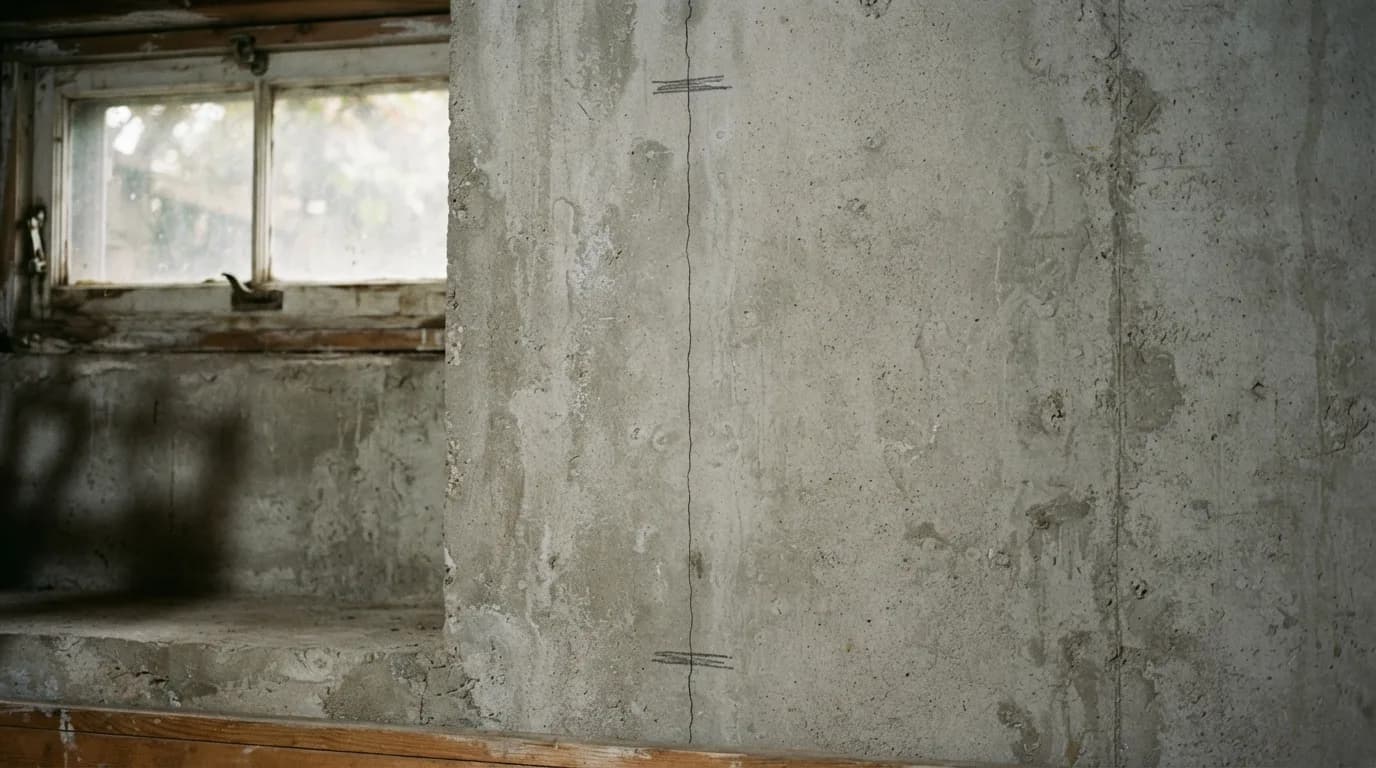
The steps below adapt those methods, and the monitoring steps published by Toronto Basement Underpinning, a GTA contractor that sells foundation repair, for a basement wall. They are a suggested routine, not a procedure any one source prescribes; the straightedge check and the dry, damp or dripping note are this guide's own additions. Draw a pencil line across each tip of the crack and date it, so you can see if the crack grows longer. Mark the spot where you measure the width, so every reading comes from the same place, and use a feeler gauge or an Allen key of known size, as Tarion describes for floor cracks, or the GSA tape marks. Lay a straightedge across the crack to see whether one face sticks out past the other, the sign InterNACHI ties to settling or heaving. Photograph the crack from the same spot each time with a ruler in the frame. Note whether it was dry, damp or dripping, and after what weather.
Run the log through a spring. Toronto Basement Underpinning describes a stable crack as one with "No change in length or width over 12 months, particularly through one full spring cycle". Its checkpoint schedule is set out in the guide to horizontal foundation cracks and bowing walls.
A log is for a crack that shows none of the signs above. A crack that already shows one needs an assessment now, and the log becomes evidence for whoever does it.
Companies
When should a crack be assessed, and who does that?
Get an assessment when the wall shows any of the signs in the section above, when the log shows the crack widening, or, for a new Ontario home, when a crack passes Tarion's line for its wall type. Two sources here name an engineer. Toronto Basement Underpinning, a GTA contractor that sells foundation repair, says a vertical crack with displacement or a widening trend needs an engineering assessment, and that any crack wider than 3 mm in a foundation wall warrants one before any repair is attempted. For a horizontal crack it says to call a structural engineer or experienced foundation contractor. The ASHI article says significant settlement must be addressed by a professional and often needs an engineered-design solution, and that for serious wall displacement an engineer should design the beam repair.
A home still under Tarion's warranty has a different first step. Tarion's guidelines say new defects should be reported in writing to both the builder and Tarion within the warranty period, and the builder's warranty covers major structural defects for two years, Tarion's for years three through seven after possession. The foundation repair permit guide covers when structural work needs a City of Toronto permit.
This index lists companies that sell the repair, not engineers, so an engineering assessment means looking outside it. Google Maps gives the 384 records in the index 21 different business labels, and none of them is an engineering label. Of the 83 companies filed under foundation repair, 52 mention cracks in the stored excerpt of their own website, and 55 use the phrase free estimate, free quote or free inspection there. That suggests a free first look at a crack often comes from a company that would also price the repair. The index has never inspected a wall.
Frequently asked questions
Is a vertical crack in a poured basement wall normal?
- It is common. Keith Swift, in an undated article for InterNACHI, a US-based home inspectors' association, says vertical cracks in foundation walls are relatively common and typically result from shrinkage. The same article says there is no absolute standard for evaluating cracks and, since in his view most cracks are the result of structural movement, that each should be recommended for further evaluation. Movement, a taper or growth is what to watch for.
How wide is too wide for a foundation crack?
- No single number applies. For new Ontario homes, Tarion says a crack over 6 mm in a poured wall, or over 2 mm in a block wall, is not acceptable. Alberta's new-home guide calls a poured-wall crack over 1/8 inch (3 mm) excessive. Both are new-home warranty rules, so for an older house they are reference points rather than a pass mark.
How long should I watch a foundation crack?
- The sources differ. The US General Services Administration procedure, on a page last updated in 2017, records readings weekly. Toronto Basement Underpinning, a GTA contractor that sells foundation repair, describes a stable crack as one with no change in length or width over 12 months, particularly through one full spring. A crack that shows displacement or is widening is a reason for an assessment, not for more waiting.
Does Tarion cover a crack in a new home's basement wall?
- It depends on the crack. Tarion's guidelines exclude cracks from normal shrinkage from the statutory warranty, and say walls with cracks over the limit for their wall type shall be repaired. Actual trickling water through a foundation wall falls under the 2-year basement water penetration warranty, whatever the width, unless an exclusion such as poor maintenance applies. Tarion says new defects should be reported in writing to both the builder and Tarion within the warranty period.
Does a leaking crack mean the foundation is failing?
- Not by itself. Tom Feiza, writing in 2007 for the American Society of Home Inspectors, says a dry basement may have serious cracks and structural problems while a leaky basement may be structurally sound. The US concrete industry group NRMCA, in a guide last revised in 2014, says the drainage around the house should be checked and corrected if necessary before a leaking crack is repaired.
Method
Where the figures on this page came from
This index has never collected a quote. Every figure above is quoted from the source named beside it, or computed from this site’s own listing records.
- Tarion, Construction Performance Guidelines for Freehold Homes and Condominium Units (updated June 6, 2024), condition 1.10
- For new Ontario homes, a crack wider than 6 mm in a poured concrete foundation wall is not acceptable, and cracks from normal shrinkage are acceptable and excluded from the statutory warranty.
- Tarion, Construction Performance Guidelines for Freehold Homes and Condominium Units (updated June 6, 2024), condition 1.7
- For new Ontario homes, a crack wider than 2 mm in a concrete block foundation wall is not acceptable, and where lateral or vertical movement is evident, further investigation may be required.
- Government of Alberta, New Home Buyer Protection Office, Performance Guide, Chapter 2 Concrete (2015), item 2.5
- For new Alberta homes, a crack in a cast-in-place foundation wall wider than 1/8 inch (3 mm) is considered excessive; if water penetration is not an issue, a cosmetic repair is acceptable.
- National Ready Mixed Concrete Association, CIP 7, Cracks in Residential Basement Walls
- In the US, a typical builder's basement warranty requires repair only when a crack leaks, has measurable vertical displacement, or is wider than 1/8 inch (3 mm).
- American Society of Home Inspectors, ASHI Reporter, Basement Cracks and Leaks (Tom Feiza, March 1, 2007)
- Some vertical shrinkage cracks in poured concrete can be up to 1/8 inch wide, and any wall movement over 1/2 inch signals a potentially serious problem.
- US General Services Administration, Monitoring and Evaluating Cracks in Masonry (page last updated Aug 13, 2017; archived copy)
- To monitor a crack, tape is placed on each side with lines drawn 2 inches apart, and the distance between them is recorded weekly and filed with photographs.
Elsewhere
Where to go next
- Foundation Repair companies in the GTA
- Foundation Crack Injection cost guide
- Foundation Repair cost guide
- Horizontal foundation cracks and bowing walls: what are the repair options?
- Foundation crack repair kits: what a DIY kit can seal
- Foundation crack injection in Toronto: what it fixes, and what it cannot
- All below-grade guides