Foundation crack repair kits: what a DIY kit can seal
Last updated: By Below-Grade Records Desk
Record
What is inside a foundation crack repair kit?
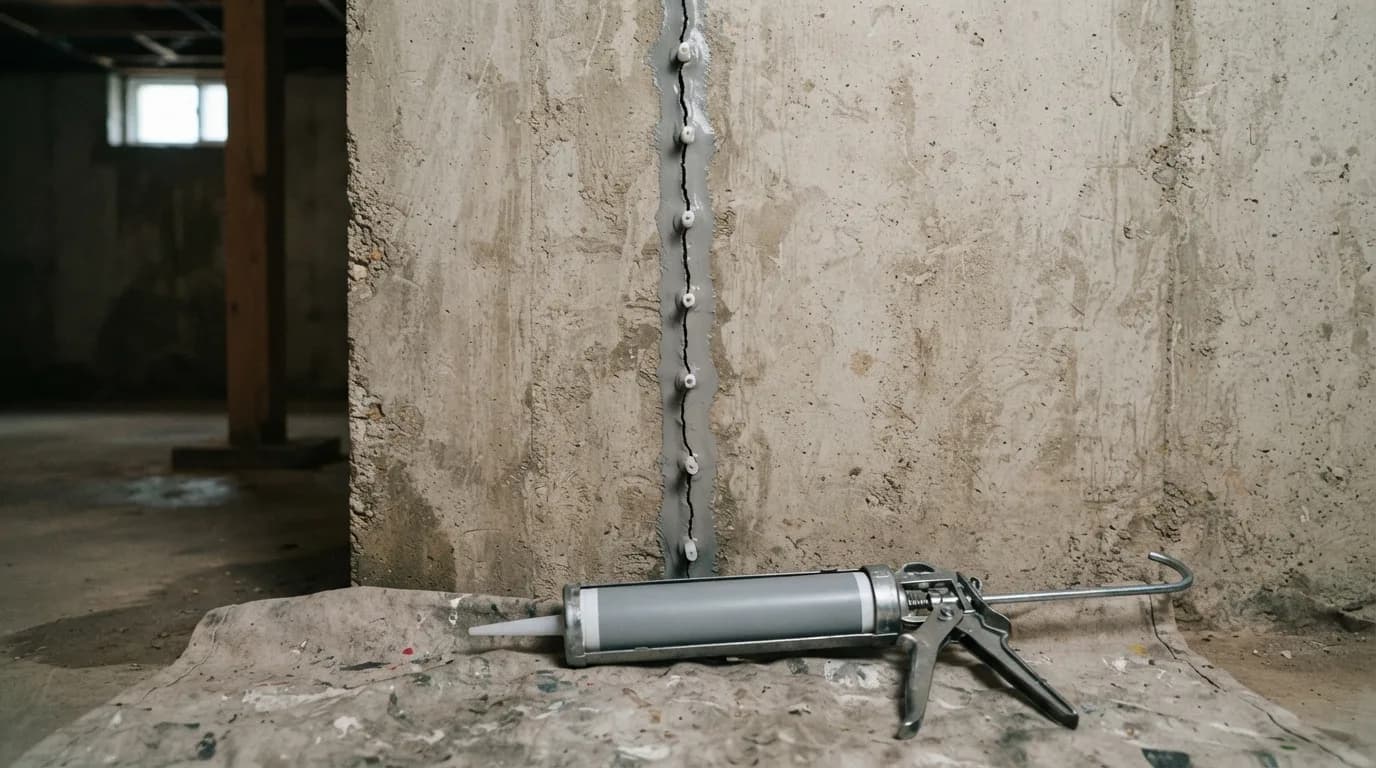
A foundation crack repair kit holds the parts of a small injection job: plastic injection ports, a paste or mortar that caps the crack, and a cartridge of resin that a caulking gun pushes into the crack. The ports are small nozzles glued over the crack at intervals. The cap seals the crack face between them so the resin cannot run back out.
DRICORE's kit instructions, a PDF hosted by The Home Depot, say the box holds materials to repair 1 wall crack: 1 tube of Crack Prep Surface Paste, 1 tube of Crack Injection Expanding Foam, 2 mixing nozzles and 10 injection ports. DRICORE's data sheets describe the paste as a two-component epoxy gel adhesive and the foam as a self-expanding polyurethane.
Sika Canada's May 2022 data sheet lists a 250 mL cartridge of polyurethane grout, 3 bags of quick-set mortar and 20 injection ports with plugs in its SikaFix Kit CA. The same sheet says the kit "may only be used by experienced professionals", even though it also calls the kit economical and easy to apply. Emecole Metro's 10 ft polyurethane kit page lists 2 cartridges of polyurethane, a surface seal in jars or peelable cartridges, gloves, safety glasses, a wire brush and a trowel, and says the caulking gun is not included. RadonSeal sells its urethane kit in 5, 10 and 20 ft sizes and says it needs only a standard caulking gun.
The resin is the main difference between kits. Emecole sells a 10 ft kit with epoxy, which it says "fuses cracks together", while Sika says its grout reacts with moisture to form "a tough and flexible foam". The site's guide to what crack injection fixes explains when each resin suits a crack.
The method is the same in the instructions from DRICORE, Sika and Emecole: start at the lowest port and move up once resin appears at the next one. DRICORE's sheet warns that injection "may take up to 4 minutes or longer per port", and that a tighter crack takes longer.
Record
How much crack does one kit cover?
One kit covers roughly one crack, and each maker measures it differently. DRICORE's instructions say each kit fixes approximately one wall crack 4 to 5 feet long, 1/16 to 1/8 inch wide and 8 inches deep. Sika Canada sizes its kit for a typical crack 2.4 m (8 ft) long, 200 mm (8 in) deep and 3 mm (1/8 in) wide.
Emecole says its 10 ft kits repair approximately 10 feet of cracks in poured concrete. RadonSeal's product page says its kit repairs cracks up to 1/2 inch wide and 10 feet long, and bases its coverage on a 1/16 inch crack in a 10 inch thick poured wall. RadonSeal adds that each kit covers up to its stated length and that more material is available if a crack needs it.
Wall thickness also sets the port spacing. Emecole's instructions place ports as far apart as the wall is thick, which they put at usually about 8 inches. DRICORE's instructions mark ports about every 6 to 12 inches, every 8 inches for a typical 8 inch wall and never closer than 6 inches, with tighter cracks needing closer ports. Sika's data sheet uses 4 to 6 inch intervals, widening to 6 to 8 inches for wider cracks.
Comparison
Which cracks does each maker say its kit is for?
The kit pages describe narrow cracks in poured concrete, and they separate a leak from a structural problem. Emecole draws the clearest line between its 2 kits. Its polyurethane kit page says it is for "typical basement wall cracks that pose no structural threat to the foundation". It describes those as shrinkage cracks usually from hairline to 1/8 inch wide, normally vertical or slightly diagonal.
Emecole's epoxy kit page covers cracks caused by settlement, soil pressure or freeze and thaw cycles, which it says are "usually diagonal, horizontal, jagged, or stair-stepped". That page gives two width limits, 1/4 inch in its description and 1/8 inch in its feature list, so ask Emecole which applies before buying it for a wider crack.
RadonSeal's urethane kit page names settling cracks, corner cracks, diagonal cracks and cracks around egress windows, then states: "Not for applications requiring structural reinforcement". It points structural repairs to a separate epoxy kit.
DRICORE's product page answers the question of whether cracks are serious by telling owners to "contact your foundation repair specialist for further review of the cracks in your foundation". DRICORE, which sells repair products, adds on the same page: "If you are noticing a crack in your foundation, most of the time it means that something has shifted or settled so it should be addressed immediately." The pages describe crack shapes, but none of them measures movement for the buyer. That call comes before the kit, and how to tell a normal shrinkage crack from one that is moving is in which foundation cracks are normal.
Comparison
Does the crack need to be dry or wet?
It depends on the kit, so follow the sheet for the one you bought. Sika Canada's data sheet says "moisture must be present to bond the mortar and activate the grout". It tells users to pre-wet the crack thoroughly and says the grout must be in contact with water to react and expand.
Emecole wants the wall face dry first. Its instructions say "The surface must be dry for proper installation of injection ports and surface seal", and if it is wet, to wait a few days or dry it with a hot air gun. Only after the seal cures, and only for polyurethane, do they pour 1 to 2 cups of water into the top port, which they say helps activate the resin.
RadonSeal says two different things. Its product page says the kit works on wet or damp cracks, with "No need to wait for the crack to dry". Its repair guide, dated 14 June 2011, says the surface must be dry for the ports and surface sealer, then flushes the crack with water before injecting. Ask RadonSeal which version matches the kit in the box.
DRICORE's product page calls its foam "ideal for vertical wet or dry crack repairs", while its foam data sheet's surface preparation step says to remove all water and dust before installation. Even Sika, the maker that wants water, asks for a surface that is "saturated but clear of standing water" when its mortar goes on.
For a crack that leaks, the sheets line up like this. Sika's data sheet describes its kit as an injection package for repairing leaking cracks in foundations. Sika, Emecole's polyurethane method and RadonSeal's guide all put water into the crack before injecting, while Emecole and RadonSeal's guide want the wall face dry for the ports and surface seal, and DRICORE's foam sheet says to remove all water first. For water running out of the crack right now, Quikrete sells a separate plug, covered in the hydraulic cement section below.
Record
What temperature does a kit need?
The sheets that set a floor put it at about 5 °C, and they want the resin warmer than that. Sika Canada's data sheet sets a minimum substrate temperature of 5 °C and a minimum material temperature of 15 °C. It says to store the kit between 10 and 32 °C, and "If frozen discard".
DRICORE's foam data sheet gives an application range of 5 °C to 43 °C. If the room is below 21 °C, it says to warm the cartridge to 21 to 24 °C for at least 1 hour before use. DRICORE's paste data sheet asks for that material to be conditioned to 18 to 29 °C. Its product page says the work can be done year round.
Emecole gives its range in Fahrenheit only, calling 40 to 100 °F ideal for its kit materials. It says that in a heated basement the outside temperature should not affect the chemicals, with one caveat: they should not be stored in freezing temperatures. RadonSeal's repair guide suggests warming polyurethane cartridges in a pot of hot water for 15 minutes, particularly for hairline cracks.
Sika's 5 °C is the temperature of the wall itself, which its sheet calls the substrate, not the air in the room.
Record
Which walls do the makers rule out?
Concrete block is the clearest exclusion. DRICORE's product page says to inject only cracks in poured concrete walls, because block walls' "hollow structure requires a different repair method". RadonSeal says its urethane kit is "Not intended for floor cracks, or cracks in concrete block walls". Emecole's 10 ft kit pages describe repairs in poured concrete.
Movement is the second limit. Emecole's epoxy page says that where "active movement continues to be a reoccurring issue, additional reinforcement may be necessary". DRICORE sells its injection kit as steps 1 and 2 of a 3-step process that ends in carbon fibre reinforcement. Its product page also says no carbon fibre system can stop a sinking or settling foundation, and points that owner to a piering contractor.
For a horizontal crack or a wall bowing inward, read the site's guide to horizontal cracks and bowing walls before buying anything.
Comparison
Is hydraulic cement a crack filler or a kit?
Hydraulic cement is a plug for running water, not an injection kit. Quikrete's data sheet for its Hydraulic Water-Stop Cement says it is made "to instantly stop flowing water from cracks or holes in concrete or masonry". The same sheet says: "Product is only for use to fill active leaks in cracks or holes".
The preparation is different too. Quikrete says to enlarge small cracks with square or undercut edges and to "avoid V-shape cuts". Sika tells its kit users to cut a V notch at least 6 mm wide and 13 mm deep in cracks narrower than 6 mm. A crack prepared for one product is not prepared for the other.
Order matters as well. Emecole's kit pages say a crack patched earlier with hydraulic cement that has started leaking again needs that cement chipped and ground out before an injection kit can reach the crack.
Record
What does a kit leave out that a hired repair includes?
A kit sells material, and the makers' terms leave the result with the buyer. DRICORE's foam data sheet makes the buyer responsible for deciding whether the product suits the job, excludes the cost of labour, and, if the product is proven to be in nonconformance, limits the remedy to "a refund of the purchase price or replacement of product". DRICORE's product page adds that its warranties apply only to the original purchaser and do not pass to a later owner. RadonSeal's repair guide says choosing the material and installing it are the "responsibility of the applicator".
So a failed DIY injection leaves the homeowner with the time spent and the next repair to arrange. A hired repair adds labour, and any warranty on the work is whatever that company puts in writing. The site's crack injection cost guide lists the prices GTA companies publish, each with its source, and the crack injection versus exterior excavation comparison covers the outside route.
To find a company in this index, start at the foundation repair page. Of the 384 companies listed, 83 are filed under foundation repair, and 62 of those 83 are also filed under basement waterproofing. Only 7 of the 384 carry the site's crack injection label, which the site folds into its foundation repair page. The index holds no warranty terms and no record of completed jobs. The route to a company is its own website or its Google record, and every unclaimed profile carries a request form whose messages reach WaterproofingIndex.
Frequently asked questions
Can I use a foundation crack repair kit on a concrete block wall?
- Not with the DRICORE or RadonSeal kits. DRICORE's product page says to inject only cracks in poured concrete walls, because a block wall's hollow structure needs a different repair method. RadonSeal's urethane kit page says it is not intended for cracks in concrete block walls. If your basement wall is block, ask a foundation company what method it would use and why.
Will a crack injection kit stop a crack that is leaking right now?
- It depends on the kit. Sika Canada's grout must be in contact with water to react, and its sheet says to wet the crack first. Emecole's instructions need a dry wall face before the ports and surface seal go on. RadonSeal's product page says its kit works on wet or damp cracks, while its 2011 repair guide asks for a dry surface. Quikrete sells a separate product, Hydraulic Water-Stop Cement, for active leaks.
Can I inject a foundation crack in winter?
- Only if the wall and the resin are warm enough. Sika Canada's data sheet sets a minimum wall temperature of 5 °C and a minimum material temperature of 15 °C. DRICORE's foam data sheet says to warm the cartridge to 21 to 24 °C for at least 1 hour when the room is below 21 °C. Emecole says a heated basement is fine but the chemicals should not be stored in freezing temperatures.
Is a DIY kit enough for a horizontal crack or a bowing wall?
- Not by Emecole's or RadonSeal's terms. Emecole sells its polyurethane kit for cracks that pose no structural threat, and RadonSeal says its urethane kit is not for structural reinforcement. Both sell a separate epoxy kit for structural cracks, which Emecole says are usually diagonal, horizontal, jagged or stair-stepped. DRICORE pairs its foam kit with carbon fibre reinforcement and says a foundation specialist should analyze a bowed wall. None of these pages measures whether your wall is still moving.
Does a DIY crack kit come with a warranty on the repair?
- Not on the repair itself. DRICORE's foam data sheet limits the buyer's remedy for a nonconforming product to a refund or replacement and excludes the cost of labour, and its product page says its warranties apply only to the original purchaser. RadonSeal's repair guide puts the choice of material and the installation on the applicator. A contractor's warranty is whatever that company puts in writing, so ask for it before work starts.
Method
Where the figures on this page came from
This index has never collected a quote. Every figure above is quoted from the source named beside it, or computed from this site’s own listing records.
- DRICORE, DRICORE PRO Concrete Repair Crack Injection Kit Instructions (PDF hosted by The Home Depot)
- DRICORE's kit instructions say each kit holds materials to repair 1 wall crack, about 4 to 5 feet long, 1/16 to 1/8 inch wide and 8 inches deep, with 10 injection ports in the box.
- Sika Canada, SikaFix Kit CA Product Data Sheet (May 2022)
- Sika Canada sizes the SikaFix Kit CA for a typical crack 2.4 m (8 ft) long, 200 mm deep and 3 mm wide, and says the kit may only be used by experienced professionals.
- Sika Canada, SikaFix Kit CA Product Data Sheet (May 2022)
- Sika Canada sets a minimum substrate temperature of 5 °C and a minimum material temperature of 15 °C for the SikaFix Kit CA.
- DRICORE, Technical Data Sheet, PRO Concrete Repair Polyurethane Injection Expanding Foam
- DRICORE gives its injection foam an application range of 5 °C to 43 °C and says to warm the cartridge to 21 to 24 °C for at least 1 hour when the room is below 21 °C.
- RadonSeal, DIY Foundation Crack Repair Kit, Urethane
- RadonSeal says its urethane crack kit is not intended for floor cracks or cracks in concrete block walls, and not for applications requiring structural reinforcement.
- Emecole Metro, Written instructions, 10 ft DIY foundation crack repair kit
- Emecole's instructions say the wall surface must be dry for the injection ports and surface seal, with ports spaced about the thickness of the wall, usually about 8 inches.
- Quikrete, Hydraulic Water-Stop Cement data sheet, product no. 1126
- Quikrete says its Hydraulic Water-Stop Cement is only for filling active leaks in cracks or holes, and that crack edges should be square or undercut rather than V-shaped.
Elsewhere
Where to go next
- Foundation Repair companies in the GTA
- Foundation Crack Injection cost guide
- Foundation Repair cost guide
- Foundation crack injection in Toronto: what it fixes, and what it cannot
- Horizontal foundation cracks and bowing walls: what are the repair options?
- Which foundation cracks are normal, and how to watch one
- All below-grade guides