Foundation crack injection in Toronto: what it fixes, and what it cannot
Last updated: By Below-Grade Records Desk
Record
What injection is, in one paragraph
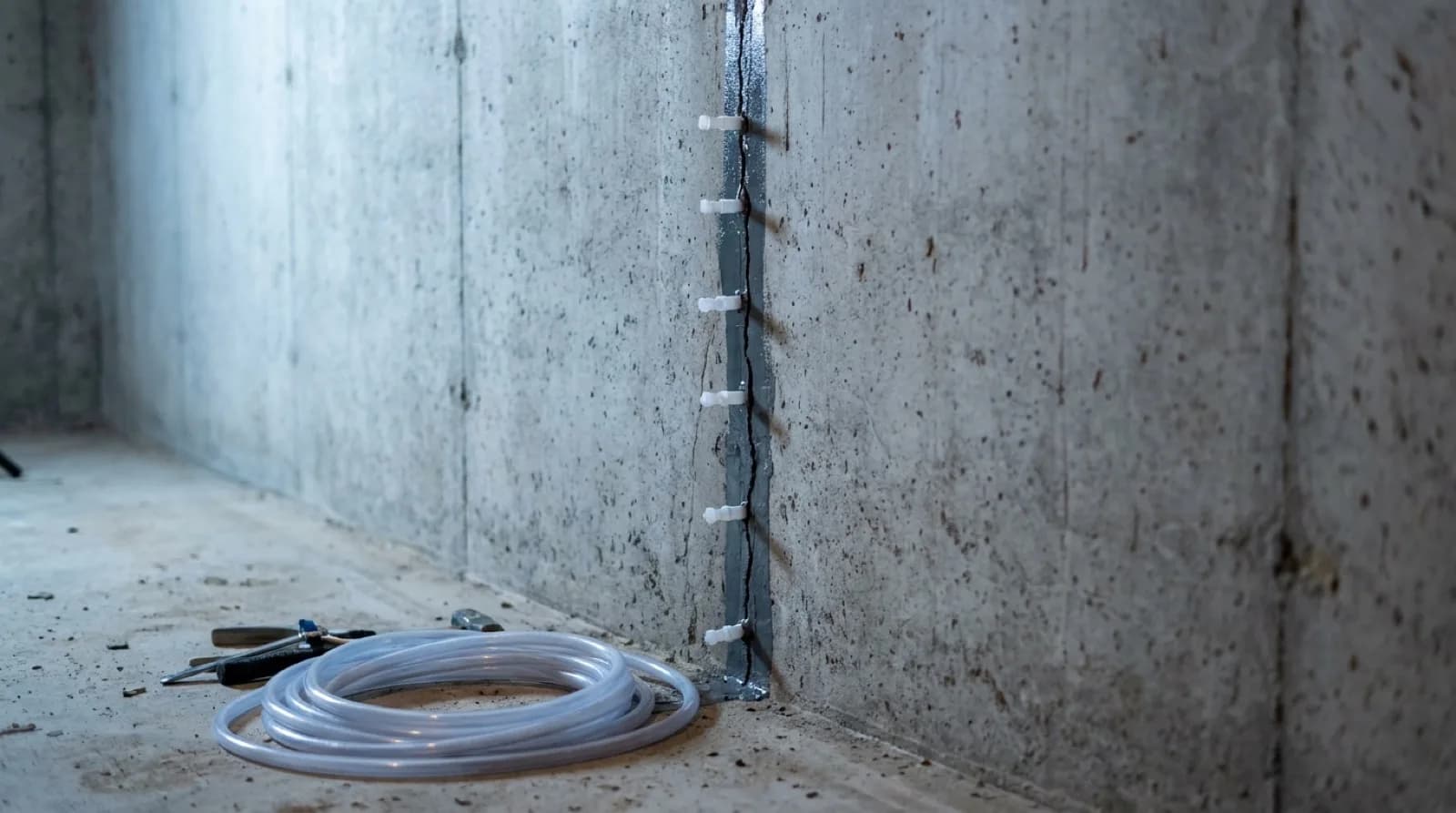
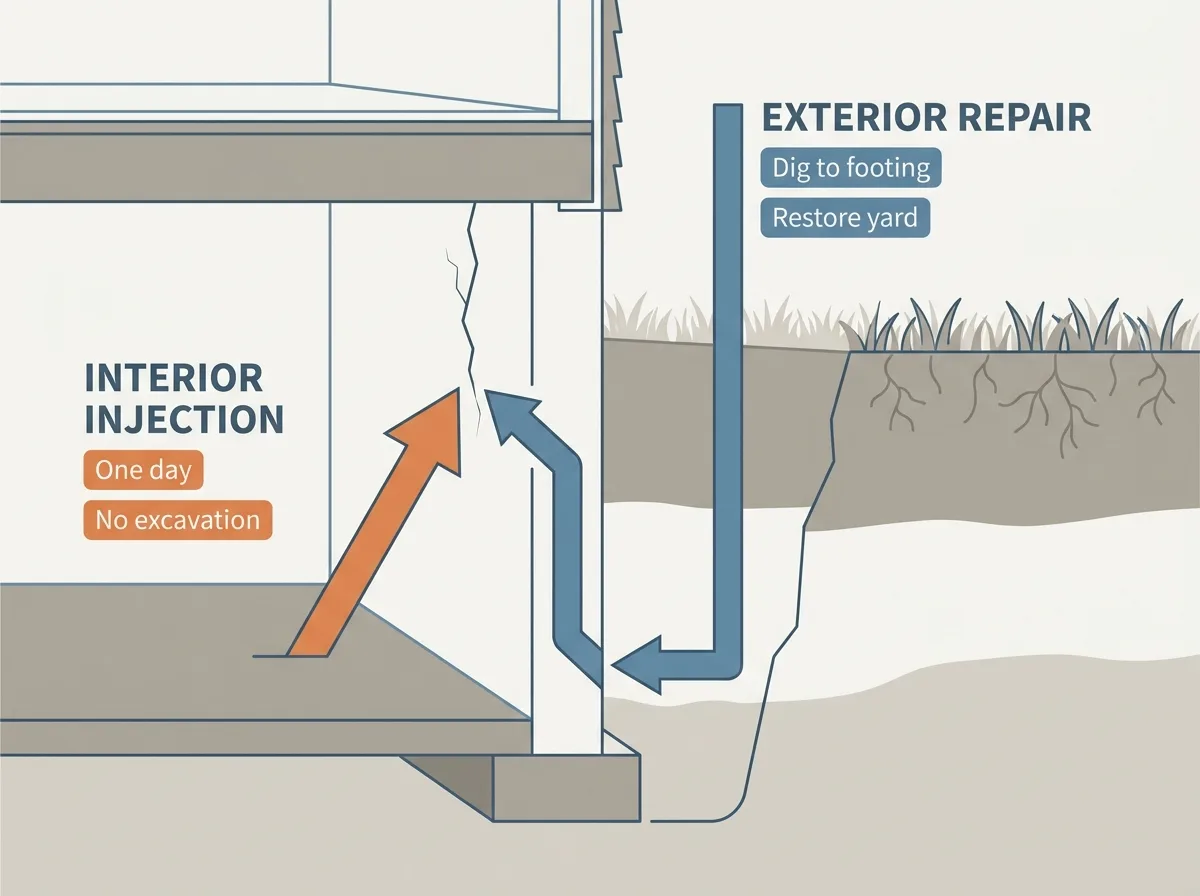
A crew cleans the crack, fixes injection ports along it at intervals, seals the face between the ports, and pumps resin in under pressure until it fills the crack through the full thickness of the wall. The surface seal and the ports come off afterwards. Gamcon describes it as a one day repair with no excavation, and DryShield says a single injection usually takes a few hours.
That is the whole job. There is no trench, no soil disposal, no landscaping to put back, and no machine on the property. Everything that makes exterior foundation work expensive is absent, which is why the price sits an order of magnitude below the excavation route and why it is worth settling whether injection will do before anyone quotes anything larger.
It is a poured concrete repair. A wall built of concrete block does not crack the same way and generally does not take injection in the same manner, which is one of the first things a contractor should establish on site.
Prices
Polyurethane or epoxy, and why it is not a price question
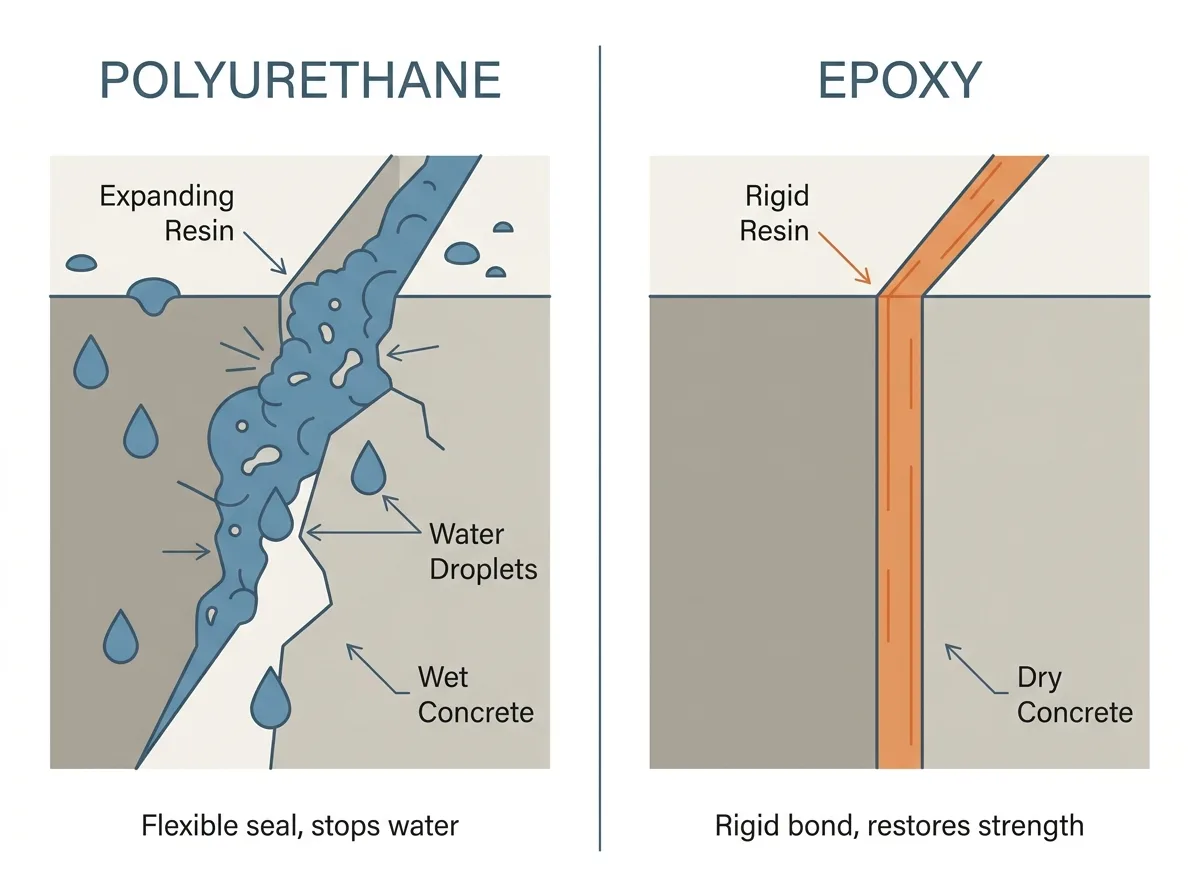
Two resins are used and they do different jobs. Polyurethane expands on contact with water and stays flexible after it cures, so it seals a crack that is actively leaking and tolerates the small seasonal movement a foundation makes. Epoxy cures rigid and bonds the two faces of the crack together, restoring structural continuity across it, which only makes sense where the crack is stable.
DryShield publishes $750 to $1,000 per crack for polyurethane and $750 to $1,500 for epoxy, and prices the material difference at up to $500 per crack. Concrete Crack Repair Pros publishes the same shape, $750 to $1,000 for polyurethane and $850 to $1,500 for structural epoxy. Toronto Basement Underpinning publishes a cheaper pair, $500 to $900 for polyurethane and $700 to $1,200 for epoxy.
The temptation is to read the cheaper resin as the better buy. DryShield's own framing is the correct one: the choice is driven by the crack, not by the budget. Epoxy in a crack that is still moving cracks again beside the repair. Polyurethane in a crack that needs structural continuity stops the water and restores nothing. Ask which resin is being quoted and why, and the answer tells you whether the contractor examined the crack or read a price list.
Prices
What the published GTA prices actually spread across
This is a category where the published numbers disagree more than usual, and knowing the spread is more useful than knowing any one figure.
At the low end, RCC Waterproofing prices internal crack repair using hydraulic cement or epoxy injection at $50 to $650 per crack, priced by the size of the crack, which is why it starts so low: the band covers small floor and wall cracks patched with cement as well as injected ones. Nusite Group quotes $300 to $800 per crack. Gamcon quotes $400 to $800 for a one day repair with no excavation.
In the middle, DryShield publishes $750 to $1,500 per crack across both resins. At the top, Leaquida Waterproofing budgets $1,500 to $2,200 for a straightforward, accessible interior injection on one leaking vertical crack, and is explicit that the figure covers prep, routing, ports, injection and surface seal, and that reinforcement is a different and dearer job.
Read that as five companies pricing five slightly different scopes rather than as one market rate with noise around it. The published spread from $300 to $2,200 for what all five call the same repair is the reason three written quotes matter here as much as on a $30,000 job. DryShield states plainly that most residential crack injection is priced per crack based on standard wall conditions, so per linear foot pricing on an injection quote is a signal to ask what changed.
Two lines get added often enough to ask about. Tie rod holes, the form tie holes left in a poured wall, run $75 to $150 each at DryShield and are charged alongside an injection rather than instead of one. And where several cracks are sealed on one visit, both DryShield and Concrete Crack Repair Pros note volume pricing, because the first crack carries the mobilisation and the rest do not.
All of these are before tax. Ontario adds 13 per cent HST to foundation repair work, so a $900 injection lands at $1,017.
Record
When injection is the wrong repair
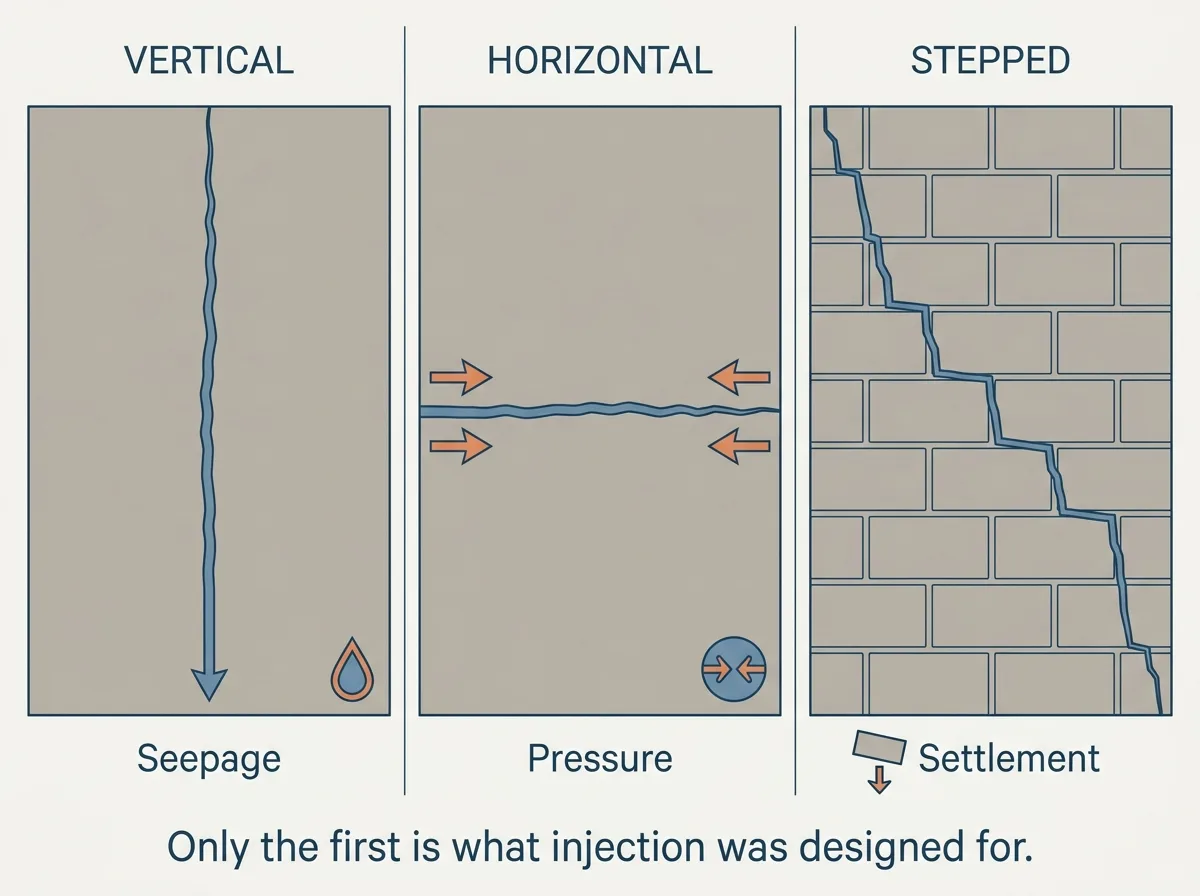
Injection fills a gap. It does not hold anything in place. The published GTA structural price lists start where injection stops, and the difference in scale is the point.
A horizontal crack, a wall that is bowing inward, or ongoing settlement is movement, and movement needs reinforcement. Toronto Basement Underpinning prices carbon fibre straps at $3,000 to $8,000 per wall and steel wall anchors at $5,000 to $12,000 per wall, and Foundation Fix prices individual carbon fibre straps at $500 to $1,000 each with a whole wall at $2,000 to $5,000. Leaquida prices stitching and reinforcement work at $7,500 and up. A wall in that condition injected and left alone cracks again beside the repair.
Deteriorated block is a different case again. Toronto Basement Underpinning puts a foundation wall replacement or rebuild at $15,000 to $40,000 per wall. Localized footing repair, where settlement is confined to one section, runs $8,000 to $25,000 per project at the same source.
The cheap safeguard against buying the wrong repair is an independent opinion. Toronto Basement Underpinning prices a structural engineer assessment at $500 to $1,000 for a standard residential case and $1,000 to $1,500 for a complex one such as a party wall, a heritage property or multiple issues, and notes the fee is often credited against the work. Against a $12,000 anchor job or a $40,000 rebuild, a report that says a $900 injection is sufficient pays for itself many times over, and so does one that says it is not.
Prices
The exterior route, and what it costs to reach the same crack
The same crack can be repaired from outside, by excavating to the footing, treating the crack on the exterior face and waterproofing the area. It is done where the interior face is inaccessible, where the wall needs exterior treatment anyway, or where an interior repair has already failed.
RCC Waterproofing prices exterior excavation to expose the foundation, repair the crack and waterproof the area at $50 to $300 and up per linear foot, printing the high end open ended. DryShield prices exterior crack repair with excavation and membrane at $150 to $250 and up per linear foot, and puts the whole job at $5,000 to $20,000 and up depending on depth and access. Gamcon prices exterior foundation repair to stop a basement leak at $100 to $300 per linear foot and says it is heavily dependent on depth and accessibility.
Set those against $750 to $1,500 for the same crack injected from inside and the single biggest saving available on a leaking crack is obvious: ask whether it can be sealed from inside before agreeing to a dig. It will not always be yes. But a contractor who moves straight to excavation on a leaking vertical crack in an accessible poured wall should be able to say why.
Record
Warranty, permits and the DIY kit
Warranty on this work is a company promise, not a provincial rule. DryShield publishes a lifetime transferable warranty on eligible poured concrete repairs and states it transfers to a new owner. Other GTA companies publish different terms. Get the warranty in writing, and read what voids it, because a transferable warranty on a foundation repair is a real asset at resale and a verbal one is not.
Interior crack injection is a repair inside an existing wall and is normally handled without a building permit. That changes the moment the scope becomes underpinning, benching or structural alteration, which are different jobs under different rules, so confirm the scope before signing rather than after.
The do it yourself route exists and the honest version of it is short. The Home Depot Canada listed a crack prep paste plus injection expanding foam kit at $89.16 on 28 August 2026, materials only. That is a real product at a real price, and a retail price moves. What it does not include is the judgment about which resin the crack needs, the pressure control that gets resin through the full wall thickness rather than just into the visible face, or anyone to call if it leaks again next spring.
Record
What this index holds on crack injection
WaterproofingIndex catalogues 384 companies across 59 Toronto and GTA areas. Exactly 7 of them carry the foundation crack injection label, and that number is the most useful thing on this page.
Six of those seven also carry the basement waterproofing label and six also carry foundation repair. Five of the seven are listed by Google Maps as a waterproofing service, one as a foundation business and one as a concrete contractor. They appear in only 3 of the 59 published areas. All 7 have a phone number and a website on record, and all 7 carry a rating, averaging 4.81 across 7 companies, which is far too small a sample to compare anything with.
Because the roster is that small and that contained inside a bigger one, this site publishes crack injection as a label on companies rather than as a hub page of its own. The link at the foot of this article goes to foundation repair, which is where those companies are listed. That is a deliberate choice: a hub whose entire roster already appears under a larger hub publishes nothing new and splits the same seven names across two URLs.
The practical reading is that crack injection in the GTA is a service offered by waterproofing and foundation companies, not a specialism you shop for separately. When you call for three quotes on one crack, you are calling waterproofing contractors, and the published spread from $300 to $2,200 per crack is exactly why all three should be in writing. This index holds no price, no warranty text and no record of completed work, so every figure on this page is quoted from the Canadian source named beside it.
Frequently asked questions
How much does foundation crack injection cost in Toronto?
- Published GTA prices vary widely for the same repair. Nusite Group quotes $300 to $800 per crack and Gamcon $400 to $800. DryShield publishes $750 to $1,500, split as $750 to $1,000 for polyurethane and $750 to $1,500 for epoxy. Leaquida Waterproofing budgets $1,500 to $2,200 for a full interior injection programme on one straightforward accessible crack. Add 13 per cent HST to all of these.
Is polyurethane or epoxy injection better?
- They are for different cracks. Polyurethane expands and stays flexible, which stops an active leak and tolerates seasonal movement. Epoxy cures rigid and bonds the crack faces, which restores structural continuity across a stable crack. DryShield prices the difference at up to $500 per crack and ties the choice to the crack rather than the budget. Epoxy in a crack that is still moving simply cracks again beside the repair.
Can crack injection fix a bowing basement wall?
- No. Injection fills a gap and holds nothing in place. A bowing wall, a horizontal crack or active settlement needs reinforcement, and Toronto Basement Underpinning prices carbon fibre straps at $3,000 to $8,000 per wall and steel wall anchors at $5,000 to $12,000 per wall. A structural engineer assessment at $500 to $1,500 from the same source is the cheapest way to find out which category your crack is in.
Do I need a permit for crack injection?
- Interior crack injection is a repair inside an existing wall and is normally handled without a building permit. It stops being that the moment the scope turns into underpinning, benching or structural alteration, which carry their own permit requirements. Confirm the scope with the contractor in writing before work starts rather than discovering the boundary partway through.
How many crack injection companies does this index list?
- Seven of the 384 companies carry the crack injection label, and six of those seven also carry basement waterproofing. They appear in 3 of the site's 59 published areas. In the GTA this is a service offered by waterproofing and foundation contractors rather than a separate trade, which is why the roster is small and why this site lists those companies under foundation repair.
Method
Where the figures on this page came from
This index has never collected a quote. Every figure above is quoted from the source named beside it, or computed from this site’s own listing records.
- DryShield (Toronto and Southern Ontario)
- Polyurethane crack injection costs $750 to $1,000 per crack and epoxy $750 to $1,500, tie rod hole sealing is $75 to $150 per hole, exterior crack repair with excavation and membrane runs $150 to $250 and up per linear foot for a whole job of $5,000 to $20,000 and up, and a single injection usually takes a few hours.
- Nusite Group (Toronto)
- Crack injection repair costs $300 to $800 per crack, with the spread tied to crack length and complexity.
- Gamcon (Toronto)
- Crack injection is a one day repair with no excavation at $400 to $800 per crack, and exterior foundation repair to stop a basement leak runs $100 to $300 per linear foot depending on depth and accessibility.
- RCC Waterproofing (Toronto)
- Internal crack repair using hydraulic cement or epoxy injection runs $50 to $650 per crack priced by crack size, and exterior excavation to expose, repair and waterproof runs $50 to $300 and up per linear foot.
- Leaquida Waterproofing (Toronto and GTA)
- A full interior injection programme on one straightforward accessible leaking vertical crack costs $1,500 to $2,200, covering prep, routing, ports, injection and surface seal, while stitching and reinforcement work starts at $7,500.
- Foundation Fix (Southern Ontario)
- An individual carbon fibre strap costs $500 to $1,000, with a whole wall at $2,000 to $5,000 depending on how many straps the wall takes.
- Concrete Crack Repair Pros (Toronto)
- Structural epoxy injection costs $850 to $1,500 per crack and polyurethane $750 to $1,000, with volume pricing where several cracks are sealed on one visit.
- Toronto Basement Underpinning
- Carbon fibre straps cost $3,000 to $8,000 per wall, steel wall anchors $5,000 to $12,000 per wall, localized footing repair $8,000 to $25,000, a foundation wall rebuild $15,000 to $40,000 per wall, and a structural engineer assessment $500 to $1,500 per report.
- The Home Depot Canada
- A DIY polyurethane crack injection kit of crack prep paste plus injection expanding foam was listed at $89.16, materials only, on 28 August 2026.
Elsewhere