Horizontal foundation cracks and bowing walls: what are the repair options?
Last updated: By Below-Grade Records Desk
Record
What a horizontal crack and a bowing wall are
A foundation wall does two jobs. It carries the house above it, and it holds back the soil packed against the outside of the basement. That soil pushes sideways on the wall all year. Contractors call this lateral soil pressure, which simply means force acting across the wall rather than down on it.
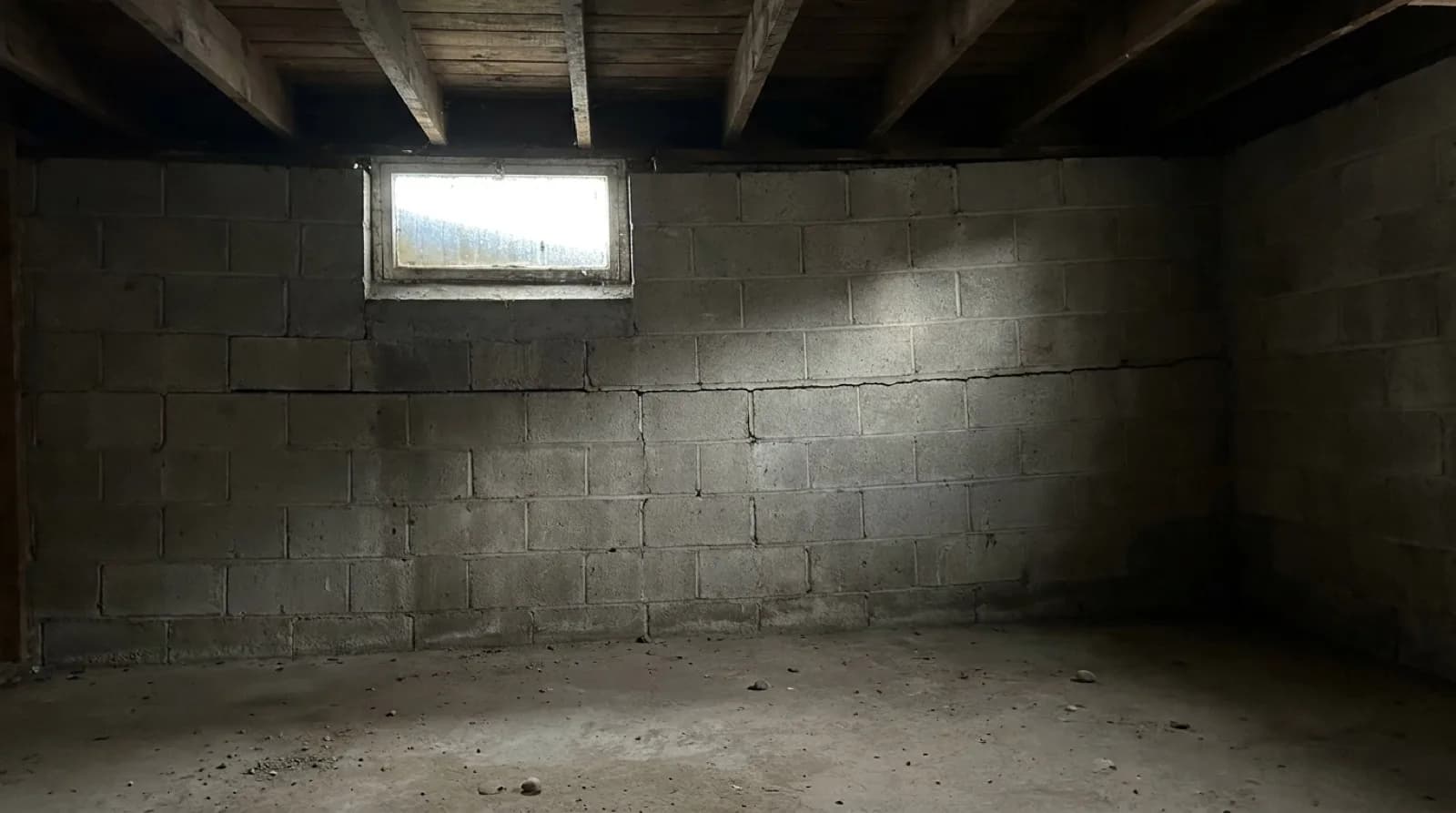
A horizontal crack runs level along the wall, roughly parallel to the floor. A bowing wall is one that has started to curve or lean inward, toward the basement. Toronto Basement Underpinning's guide to foundation cracks says a horizontal crack shows that the sideways soil pressure has become more than the wall can resist, and that the wall can bow inward as the crack widens.
The kind of wall matters. Gamcon's Toronto cost page says concrete block walls are more prone to horizontal bowing, while poured concrete is more prone to diagonal or vertical cracking. Toronto Basement Underpinning's crack guide adds that in a block wall the horizontal crack tends to appear at mid-height, which it calls the point of maximum bending stress.
That crack guide also names two local causes: frost heave, the swelling of frozen soil in winter, and Toronto clay that expands when wet, which it says puts horizontal stress on walls, particularly in wet spring seasons.
Record
Foundation cracks vertical vs horizontal: what does the direction tell you?
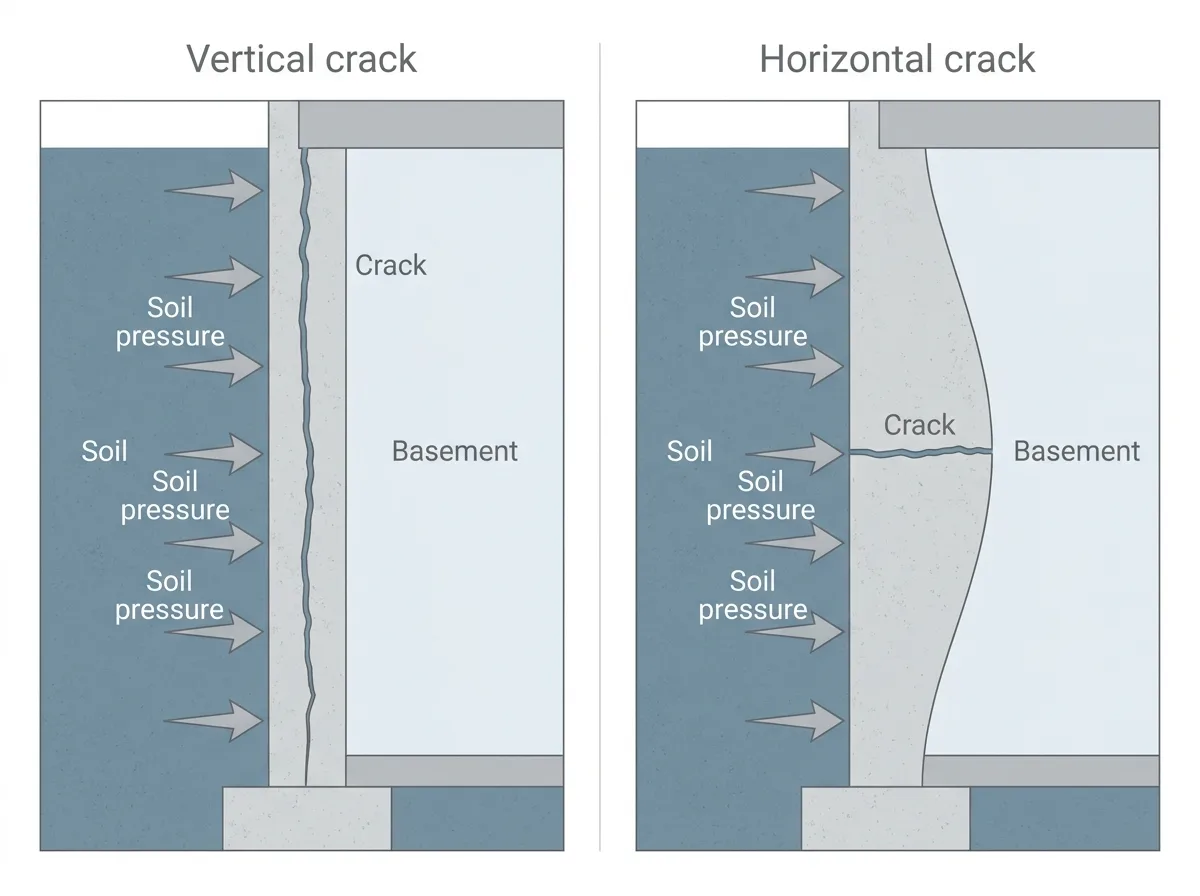
Most vertical cracks in poured walls start as shrinkage. Poured concrete shrinks slightly as it cures. The same crack guide says this leaves hairline to moderate vertical cracks that are the most common type in post-1950 homes and often benign. Leaquida Waterproofing's cost page says most vertical seams are shrinkage related and do not indicate loss of wall capacity.
Horizontal cracks sit at the other end of the same guide's severity table. It rates a horizontal crack in either a block or a poured wall as "high to critical", with the action "engineering assessment now". A hairline vertical crack with no water is rated low, and the action is to monitor it. Gamcon calls horizontal cracks along basement walls a major red flag that points to pressure from the soil outside.
Direction is a clue, not a full answer. Toronto Basement Underpinning's crack guide also sends a vertical crack to an engineer when it shows displacement, meaning one side of the crack has shifted out of line with the other, or when it keeps widening. It says the same for any crack wider than 3mm. Stair-step cracks that follow the mortar joints in brick or block walls are a third pattern. The guide links them to one part of the footing, the concrete base under the wall, sinking more than the rest.
This index has not looked at any wall. In these sources, direction decides who should look next.
Record
Why can't a horizontal crack just be injected?
Crack injection means pumping a resin into a crack from inside the basement to seal the path water takes through the wall. The index's explainer on what foundation crack injection fixes covers the method and its prices in full.
Toronto Basement Underpinning's cost guide draws a firm line. It says injection is appropriate for stable, vertical, non-displacing cracks in poured concrete walls, and not appropriate for horizontal cracks, active settlement (part of the wall or footing still sinking) or crack patterns that show ongoing movement. Its crack guide adds that injecting an active crack is money wasted. Leaquida's page makes the same point in plainer words: if the wall is moving, a seal on its own is not a responsible repair.
The sources do not all say the same thing. Foundation Fix lists injection for leaking cracks, horizontal or vertical, as long as they are non-structural, and moves to carbon fibre straps for more significant cracks or bowing walls. The two pages disagree on that point, and this index reports both. Where they do agree is the bowing wall: once the wall is moving, sealing alone is not the repair.
The price gap shows why the call matters. Leaquida budgets $1,500 to $3,000 for an interior injection on one leaking vertical seam, and $7,500 to $15,000 or more once a horizontal line or mild bow means straps or anchors are added. Leaquida adds that a wall with a horizontal line and several vertical cracks usually gets a blended plan and a blended budget.
Record
Carbon fibre straps, wall anchors and braces: how the repairs differ
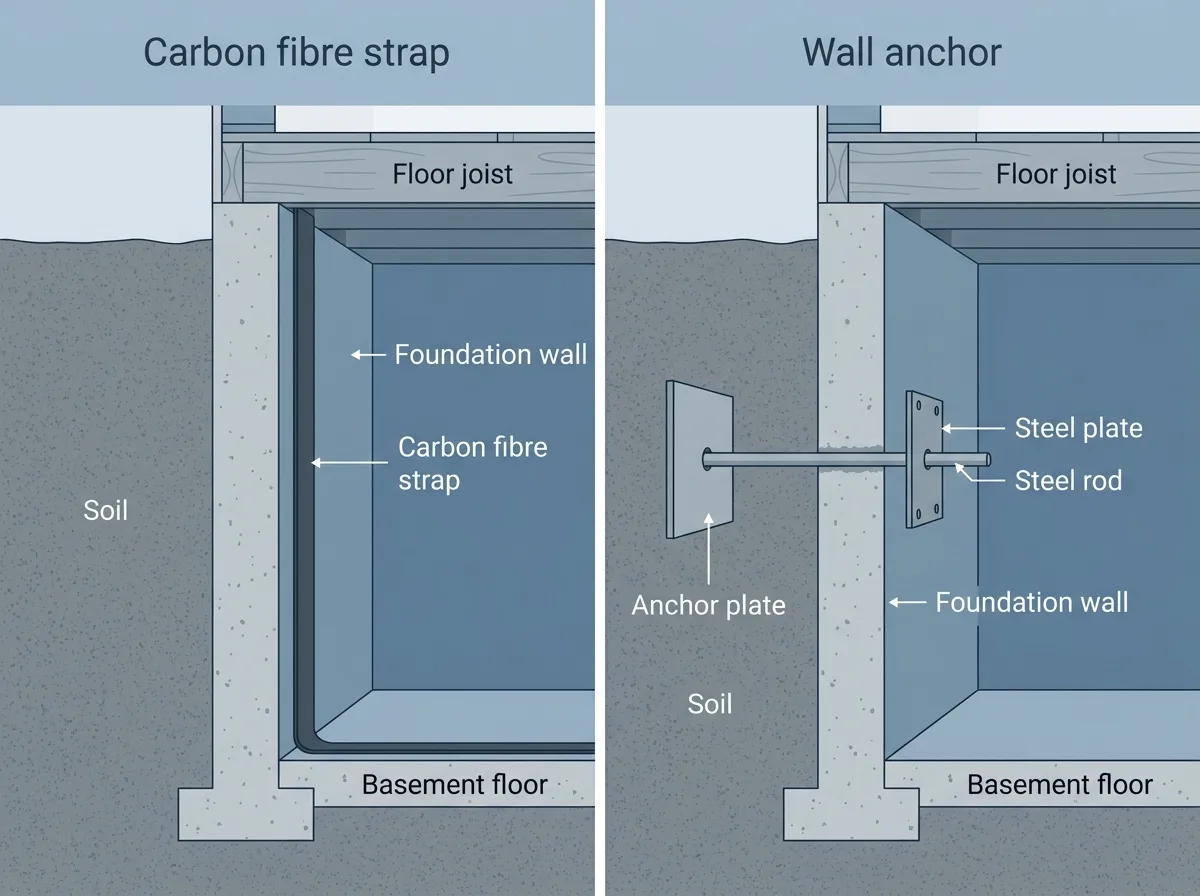
A carbon fibre strap is a flat band fixed to the inside face of the wall. Toronto Basement Underpinning's cost guide says the straps are set in epoxy, a strong glue. They are anchored to the floor joist above, one of the wooden beams that carry the floor, and to the basement floor below, so they resist further inward movement. The same guide says straps are typically spaced one per 4 to 6 feet of wall.
Straps hold a wall where it is. The guide is direct that carbon fibre straps do not correct an existing bow, they only stop it getting worse. It adds that if a wall has already bowed more than 25mm inward, straps alone may be insufficient and anchors or replacement may be needed.
A wall anchor works from the yard. The guide describes a steel plate on the inside face of the wall, joined by a steel rod to a second plate buried in the soil outside. Unlike a strap, it says, an anchor can in some cases be gradually tightened over time to pull back some of the existing bow. That needs digging room outside, so the guide notes anchors require access to the exterior yard.
Braces are the third kind of hardware in these sources. Gamcon mentions installing steel beams to keep a bowing wall in place. Leaquida says that where movement is significant, an engineered scheme with more hardware and possibly interior bracing pushes the budget up. Neither page publishes a separate price for beams or bracing, so this article has none to report.
Prices
What the published GTA prices say for straps and anchors
Every figure here is quoted from the named company's own page. These are contractors that sell the repairs they price. Of the four, only Gamcon has a record in this index, and the index takes no money from any of them. The pages do not all say whether tax is included, so ask whether a quote adds HST, Ontario's 13% sales tax. The index has not collected a quote for any of these repairs.
Toronto Basement Underpinning prices carbon fibre straps at $3,000 to $8,000 installed and wall anchors at $5,000 to $12,000 installed.
Foundation Fix, writing about Southern Ontario, prices carbon fibre straps at $2,000 to $5,000 per wall or $500 to $1,000 per strap, depending on the size of the wall and the number of straps. Leaquida puts a span, meaning one stretch of wall, with mild bowing at about $7,500 to $15,000 or more. Its own worked example, a long panel with a horizontal line and a mild inward bow fixed with straps and local sealing, comes to about $7,500 to $14,000. Gamcon's table lists wall stabilization at $5,000 to $15,000 and up.
The sources name what moves the price. For straps, Toronto Basement Underpinning lists the number of straps, whether a finished wall has to be opened, and whether the joist above can take the upper fixing. For anchors, it lists the number of anchors, the distance from the wall to stable soil, and what sits in the yard, such as landscaping or buried utilities. Leaquida adds wall length, access around utilities and whether engineering is needed.
The foundation repair cost guide for Toronto lists these rows with their sources, and the foundation crack repair cost tool sets them beside injection prices.
Record
When does a bowing wall get rebuilt instead?
Some walls are past reinforcing. Toronto Basement Underpinning's cost guide prices foundation wall replacement at $15,000 to $40,000 per wall, for a wall that is severely damaged or has collapsed. It names collapsed block, badly compromised poured concrete and significant bowing as the cases. The job, as it describes it, means propping up the floor above, taking the old wall out, building a new poured or block wall and restoring the finishes.
The guide calls replacement less common than the other repairs on its list, and says it does occur in very old Toronto homes, particularly pre-war brick or stone foundations. The same company's crack guide, a separate page, gives wall replacement as $15,000 to $35,000 and sets it against straps at $3,000 to $8,000 to argue that early action costs less. The two pages differ at the top of the replacement range, and this article cites each figure to the page that prints it.
A sinking wall is a different problem from a bowing one. Toronto Basement Underpinning's cost guide prices localized footing repair, where settlement is confined to one section of footing, at $8,000 to $25,000. Deeper settlement leads to underpinning, which the index covers in underpinning versus bench footing. Permit questions for structural work are covered in the index's guide to foundation repair permits in Toronto.
Prices
Who should look at the wall first, and what does that cost?
Both main sources point to a structural engineer before a contractor price. Toronto Basement Underpinning's cost guide strongly recommends an engineer's assessment before getting quotes, and says that without one a homeowner may get quotes for the wrong repair or for work that is not needed. Foundation Fix says an engineer diagnoses the problem, recommends the repair method and provides stamped drawings, meaning plans that carry the engineer's seal, for permits and contractors.
The two sources price that visit differently. Toronto Basement Underpinning says Toronto engineers typically charge $500 to $1,000 for a standard house. Complex cases cost $1,000 to $1,500, such as party walls (a wall shared with the house next door), heritage homes or several problems at once. Foundation Fix puts an assessment and report at $800 to $2,500. Toronto Basement Underpinning adds that the fee is often credited toward permit drawings if structural work is confirmed.
The same cost guide lists warning signs in quotes. It says never to accept a phone quote for foundation repair, and it lists a contractor who does not recommend an engineering assessment as a red flag for anything beyond crack injection. That is a contractor's stated view, not a City rule.
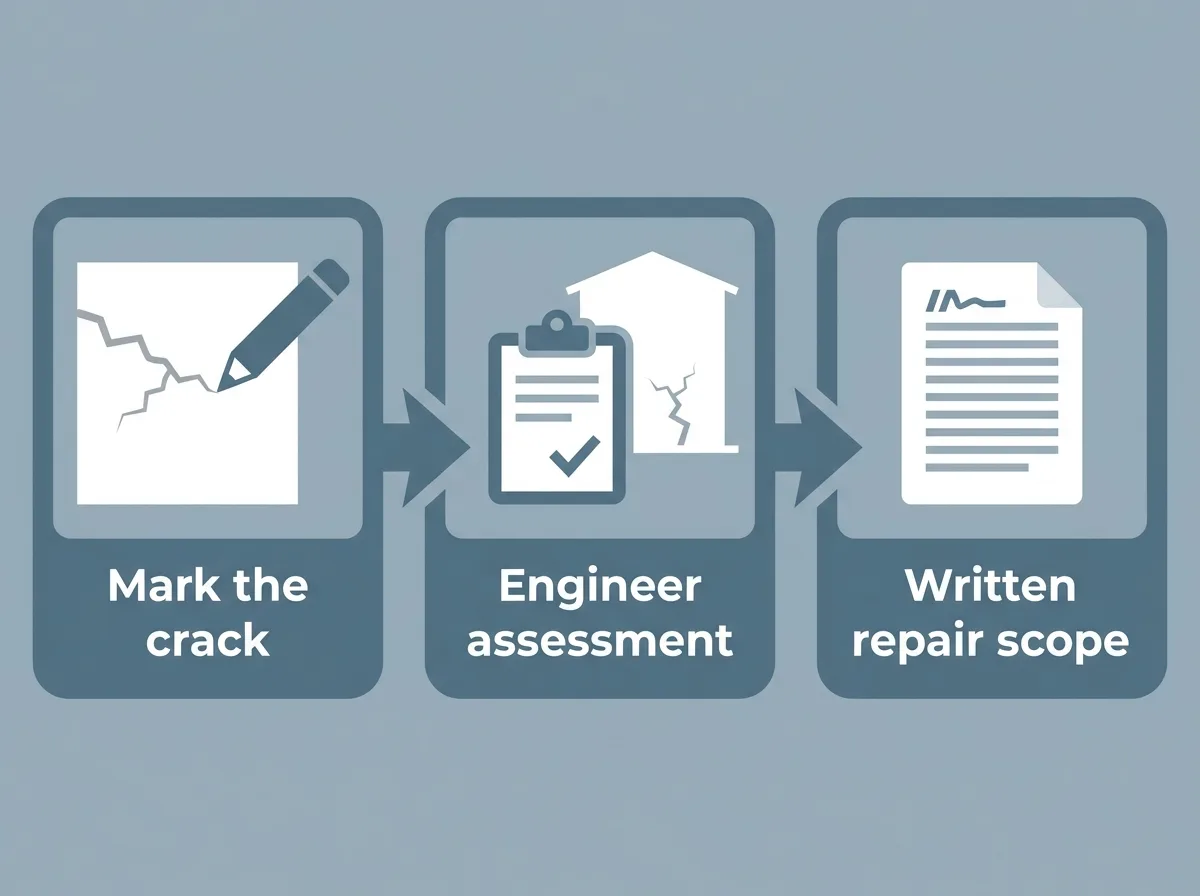
Timing is where horizontal cracks differ most. The crack guide says a horizontal crack needs professional assessment right away, without six months of monitoring first. For cracks it places in the monitoring group, it describes marking and dating both ends, then checking again at 30, 90 and 180 days. It treats no change over 12 months, including one full spring, as stable.
Record
What this index holds on foundation repair
Of the 384 companies in this index, 83 are filed under foundation repair companies in the GTA. Of those 83, 62 are also filed under basement waterproofing, 12 under underpinning and 6 carry the crack injection label. 82 have a website on record and 76 carry a Google rating. Google Maps lists 51 of the 83 as a waterproofing service and 18 as a concrete contractor. They sit in 21 named areas, and 21 more have no area assigned.
The index also stores a short excerpt of text from each company's own website. In that stored text, 8 of the 83 foundation repair companies mention carbon fibre, a bowing wall or wall anchors: 6 mention carbon fibre, 5 mention bowing and 2 mention wall anchors. The excerpt is only a slice of each site, so the real number offering these repairs is unknown and is likely higher.
That is where the index's knowledge stops. It has never collected a quote, inspected a wall or checked a finished strap or anchor job. It holds no list of structural engineers and no data on how long any of these repairs last. A company appearing under foundation repair is a record in a directory, not a recommendation, and every price on this page comes from the source named beside it.
WaterproofingIndex charges homeowners and contractors nothing, and no company pays for its place on a list. A request sent through the site's quote form reaches WaterproofingIndex by email, and the site's page for contractors says no enquiry has yet been passed to any company.
Frequently asked questions
Is a horizontal crack in a basement wall serious?
- The sources treat it as the most serious crack pattern. Toronto Basement Underpinning's crack guide rates a horizontal crack in a block or poured wall high to critical and says it needs an engineering assessment right away. Gamcon calls it a major red flag pointing to soil pressure from outside. This index has not inspected any wall and cannot judge a particular crack.
Do carbon fibre straps straighten a bowed wall?
- No, according to Toronto Basement Underpinning. Its cost guide says straps stop a bowing wall from moving further inward but do not correct the existing bow. It says wall anchors can in some cases be tightened over time to recover some of the bow, and that straps alone may not be enough once a wall has bowed more than 25mm.
How much does it cost to fix a bowing basement wall in Toronto?
- Published figures vary widely. Toronto Basement Underpinning prices straps at $3,000 to $8,000 and anchors at $5,000 to $12,000. Foundation Fix gives $2,000 to $5,000 per wall. Leaquida budgets about $7,500 to $15,000 or more for mild bowing, and Gamcon lists wall stabilization at $5,000 to $15,000 and up. Ask whether a quote includes HST.
Can a horizontal foundation crack be fixed with injection?
- Toronto Basement Underpinning says injection is not appropriate for horizontal cracks or cracks showing ongoing movement. Foundation Fix lists injection for non-structural cracks in either direction. Both sources move to straps or other reinforcement once a wall is bowing. Leaquida says that if the wall is moving, sealing alone is not a responsible repair.
Should I call an engineer or a contractor first?
- Toronto Basement Underpinning strongly recommends a structural engineer's assessment before collecting contractor quotes, and prices it at $500 to $1,500. Foundation Fix prices an assessment and report at $800 to $2,500 and says the engineer recommends the repair method and provides stamped drawings. This index lists contractors only, not engineers.
Method
Where the figures on this page came from
This index has never collected a quote. Every figure above is quoted from the source named beside it, or computed from this site’s own listing records.
- Toronto Basement Underpinning, Foundation Repair Cost in Ontario: 2026 Price Guide
- Carbon fibre straps cost $3,000 to $8,000 installed and wall anchors $5,000 to $12,000 installed; straps do not correct an existing bow, and anchors can be tightened over time to recover some of it.
- Toronto Basement Underpinning, Foundation Repair Cost in Ontario: 2026 Price Guide
- Foundation wall replacement costs $15,000 to $40,000 per wall, and localized footing repair $8,000 to $25,000.
- Toronto Basement Underpinning, Foundation Repair Cost in Ontario: 2026 Price Guide
- A structural engineer assessment costs $500 to $1,000 for a standard residential case and $1,000 to $1,500 for complex cases.
- Toronto Basement Underpinning, Foundation Cracks That Need Repair
- A horizontal crack in a block or poured wall is rated high to critical with the action engineering assessment now, any crack wider than 3mm warrants an assessment, and wall replacement is given as $15,000 to $35,000.
- Foundation Fix, The Ultimate Guide to Foundation Repair Costs in Southern Ontario
- Carbon fibre straps cost $2,000 to $5,000 per wall or $500 to $1,000 per strap, and a structural engineer's assessment and report costs $800 to $2,500.
- Leaquida Waterproofing, Foundation Crack Repair Cost Toronto
- Interior injection on one leaking vertical seam costs $1,500 to $3,000, a span with mild bowing about $7,500 to $15,000 or more, and a long panel with a horizontal line and mild bow about $7,500 to $14,000.
- Gamcon, How Much Does Foundation Repair Cost in Toronto
- Wall stabilization costs $5,000 to $15,000 and up, and block walls are more prone to horizontal bowing than poured concrete.
- Government of Ontario, Harmonized Sales Tax (HST)
- The Harmonized Sales Tax is currently 13% in Ontario.
Elsewhere