Foundation piers for a settling house in Toronto: push, helical or underpinning
Last updated: By Below-Grade Records Desk
Comparison
Which repair does a settling foundation need: piers or underpinning?
Have a structural engineer decide, after assessing the house and its soil. Hubbell's design manual says "All foundation systems should be designed under the direct supervision of a Registered Professional Engineer". Toronto Basement Underpinning, which sells this work, says localized footing repair addresses settlement confined to one section of the foundation, and that full perimeter underpinning is "required when existing footings are too shallow to safely bear the structure", or when settlement runs across the whole foundation. Foundation Fix, a Southern Ontario company that lists piering among its services, says underpinning is "often used for foundations that have settled significantly" and lists helical piers as best for settling foundations and unstable soil. Techno Metal Post, which installs helical piles, says its engineers "analyze your structure and soil conditions to determine the suitable pile type".
So the first step is that assessment, before any pier or underpinning quote. Toronto Basement Underpinning publishes $500 to $1,500 for a structural engineer assessment and says the fee buys "a confirmed diagnosis, a specified repair method". Foundation Fix says an assessment and report "typically range from $800 to $2,500".
Settlement is a footing going down as the soil under it compresses. Hubbell, which makes Atlas Resistance piers, says they are used to "restore and/or stabilize homes and commercial structures that settle". Foundation Fix files piers under "more severe structural issues where the foundation needs to be stabilized or raised", not under crack repair, and lists uneven or sloping floors and doors or windows that stick among the signs that call for a foundation repair specialist or a structural engineer.
Foundation Movements, a 1972 National Research Council of Canada (NRC) digest that the NRC now keeps as a historical reference, says the danger is uneven sinking, which engineers call differential settlement. In its words, "Within reason, there is less concern for the total settlement of a building than for differential settlement", because uneven settlement "may cause cracks or even structural failure". Its causes include soil that compresses more in one spot than another, footings of different sizes and footings set at different depths.
It also says two common assumptions are both wrong: that a foundation will not move, and that a crack proves it did and that nothing else caused it. "Neither assumption is correct", it says. The guide to normal foundation cracks covers how to tell a shrinkage crack from one that is growing. A wall bowing inward is a sideways push, not settlement, and the guide to horizontal cracks and bowing walls covers the straps and anchors used there.
Record
What does a foundation pier do?
A pier carries the weight of part of the house past soft soil to a firm layer below. Hubbell, which makes both CHANCE helical piles and Atlas Resistance piers, says in its design manual that a helical pile "transfers a structure's dead and live loads to competent soil strata deep below grade". Dead loads are the house's own weight, and live loads are its contents and occupants.
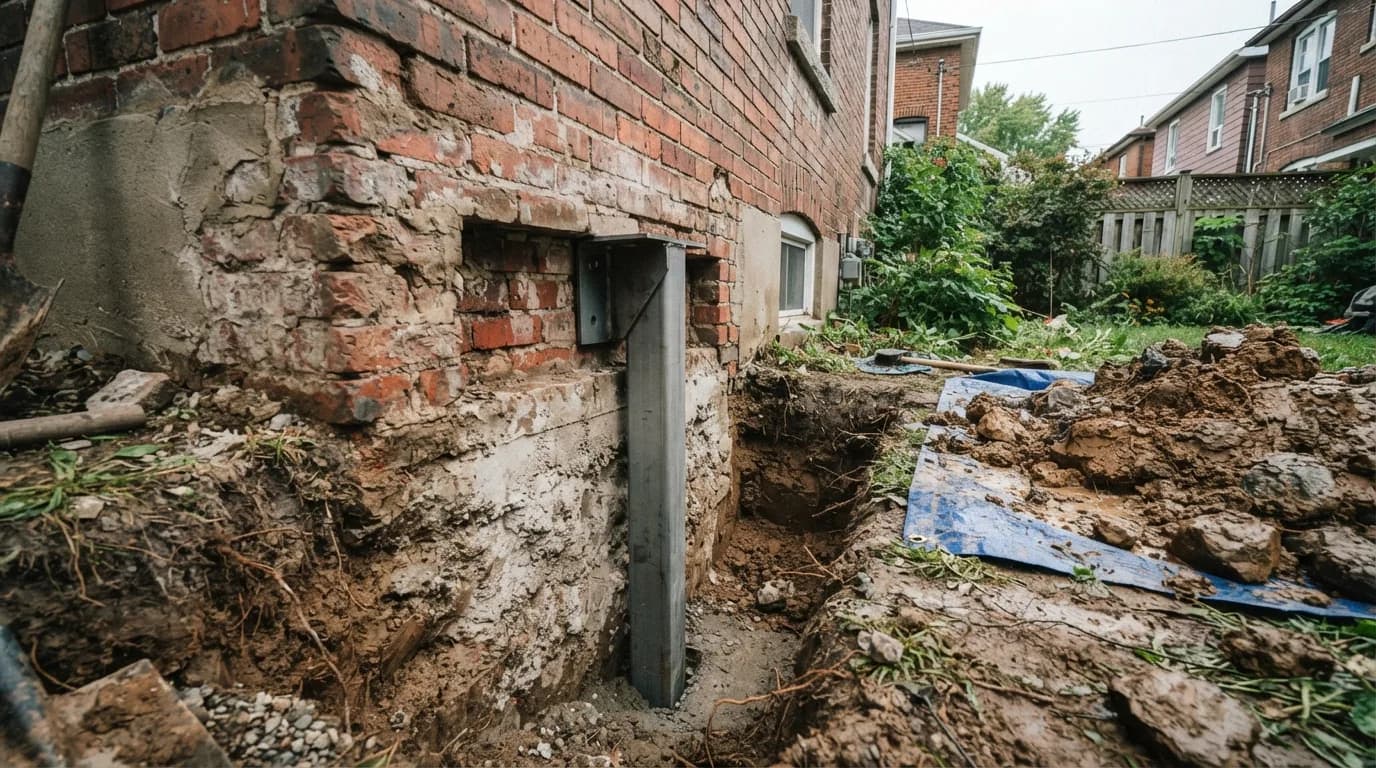
A steel bracket joins the pier to the house. Techno Metal Post says on its Canadian site that its piles are screwed in "until they reach dense and compact soil". Its brackets are then "bolted to the bottom of the structure and welded to the piles", so the pier, not the soft soil, now holds that section of footing.
A pier job can aim to stop the sinking or to raise the house back up. Techno Metal Post says it can "straighten or gradually lift foundations, depending on the nature of the problem", and Hubbell's push pier system lifts in a second stage, described below.
Record
How do push piers and helical piers differ?
A push pier is steel pipe pressed down in sections with the house's weight as the counterweight, and it bears on a firm layer at its tip. A helical pier is screwed in, and its capacity is read from the turning force. Hubbell's manual says its Atlas pier, also called a resistance pier, uses "the weight of the structure as its reaction system to drive or push the pipe pier sections into the soil". The sections are driven "until the required load is achieved or structure lift occurs", so the house's weight limits how hard a push pier can be pushed. Its strength comes "primarily from end bearing on a hard/dense soil stratum", meaning the tip sits on a firm layer.
Hubbell's Atlas page describes the job in two stages: "First, the pier pipe is driven to a firm bearing stratum; then the lift equipment is combined with a manifold system to lift the structure". Each pier is "tested to a force greater than required to lift the structure", which acts as a load test before the lift. The manual says the equipment fits in "an area that measures approximately three feet square", from inside or outside the footing.
A helical pier is a steel shaft with one or more screw-shaped plates, turned into the soil by powered equipment. Hubbell's manual says installers read its strength from the turning force, or torque: "Dense soil requires more torque (more energy) to install compared to a soft soil". Techno Metal Post says its equipment "continuously measures the driving torque" during installation. Sellers use both words, pier and pile, so a quote may say either.
Neither maker's material gives a homeowner a rule they can apply without a soil test. Hubbell's manual has a product selection chart keyed to soil-test results, and says it "is intended for use on a preliminary basis". Hubbell's manual says the advantages of its resistance piers are similar to those of its helical piles, that the resistance piers "are used primarily for remedial repair applications involving an existing structure", and that "Each project has unique factors that determine the most acceptable foundation system". Which one suits a given house is decided in the engineer's assessment.
Record
How is a pier job different from underpinning?
A pier job leaves the old footing in place and hangs it on steel shafts taken down to firm soil. Underpinning, in the City of Toronto's definition, is "constructing new footings beneath the existing footings". The City adds that "One may also underpin to reinforce an existing foundation". Toronto Basement Underpinning describes a localized footing repair as "excavating beneath the settled footing section, extending the footing to a stable bearing depth, and pouring new concrete", and says it is sometimes called partial or localized underpinning.
The word underpinning is used for both, though. Hubbell's manual says its Atlas pier provides "foundation underpinning support", and Foundation Fix calls helical piers "a less invasive alternative to traditional underpinning in many cases", which is a seller's claim, not a neutral finding. So a quote that says underpinning may mean poured concrete or steel piers.
Underpinning to lower a basement for more ceiling height is a different job, covered in the guide to underpinning and bench footing.
Record
What do Ontario's building code and the City of Toronto require?
Plan on an engineer and confirm the permit with Toronto Building: Ontario's code sends deep foundations to its structural design rules, the City requires an engineer's testing and reports on every underpinning job, and the City's guide does not mention piers. The 2024 Building Code, O. Reg. 163/24, which replaced the 2012 code on 1 January 2025, says in Article 9.4.4.1.(3) of its rules for houses and small buildings that "The design procedures described in Section 4.2. shall be used where, (a) deep foundations are used". Section 4.2, in Part 4 (Structural Design), says a deep foundation supports a building "by transferring loads by end-bearing to a competent stratum at considerable depth below the structure" or by friction in the soil. Hubbell describes its push pier as end-bearing, the first of those, and its manual says "In its simplest form, the helical pile/anchor is a deep foundation element".
The City of Toronto's underpinning permit guide says: "In all circumstances of underpinning, whether the underpinning was required to be designed by a Professional Engineer or not, you will be required (at the minimum) to provide testing and reports by a Professional Engineer during the first and last stages of the construction in order to pass inspections". It also asks for professional design and field review, meaning the designer checks the work on site, in three cases, one of them where "the soil is clay or silt". Ask the engineer which applies to your lot. The guide does not mention piers or piles, so ask Toronto Building which permit stream a pier job falls under before work starts. The guide to foundation repair permits covers what the City lists as permit work and its 2026 fees.
The maker's manual points the same way. It says "Design should involve professional geotechnical and engineering input" and "Independent engineering analysis and consulting state and local building codes and authorities should be conducted prior to any installation". That wording points to US state codes. In Toronto the equivalents are the 2024 Ontario code and Toronto Building.
Prices
What does a foundation pier cost in Ontario?
Foundation Fix publishes a typical range of $2,000 to $5,000 per helical pier for Southern Ontario, with "most projects requiring multiple piers", and says "A full project could be anywhere from $10,000 to $50,000+"; its page lists peo.on.ca and HomeGuide, a US cost site, as its "Sources for cost quotes". It gives no Toronto figure and no push pier figure, and it is the only per-pier figure on the price pages checked for this guide. The foundation repair cost page carries the published prices for localized footing repair, underpinning a settled footing and engineer assessments, and the underpinning cost page carries full underpinning.
Companies
Which listed companies mention piers, and is Perma Pier one of them?
Five companies in WaterproofingIndex mention piers on their own websites, and Perma Pier is not one of them. An Internet Archive copy of permapier.com's about page, saved on 13 December 2025, is titled "Perma Pier Foundation Repair | Texas Foundation Specialists", lists only Texas cities under Locations and signs off as "Perma Pier Foundation Repair of Texas". The site itself did not load when this guide was checked on 15 October 2026. No record in the index carries the name.
The index stores only a short excerpt of each company's website, so 5 is a floor, not a full count. Of its 384 companies, 347 have stored website text (an excerpt, headings, a title or a description). Searching that text for pier, piers, piering or helical finds 5 records, and searching it for underpinning finds 111.
The five are Basement Systems Toronto in Pickering, Basement Technologies at a Hamilton address, GAMCON Helical Piles & Waterproofing in Etobicoke, Concrete Master in Mimico and Acesbasements in Burlington. Three of them, Basement Systems Toronto, Basement Technologies and Acesbasements, are among the 83 companies on the foundation repair page. The index holds no data on which pier system any company installs, how deep it drives, or what it guarantees.
Questions
What should you ask before signing a pier quote?
Ask first whether an engineer has assessed the house and drawn the pier layout, and who pays for that report. Then ask whether the price is for push piers, helical piers or concrete poured under the footing, whose pier system it is, and to see the maker's installation document for that system. Ask how many piers the price includes, where they go, and what depth or installation force it assumes. Ask who applies for the permit and books the inspections. Finally, ask who stands behind the steel and who stands behind the installation, and get both answers in writing: Hubbell's manual says Hubbell "does NOT warrant the work of its dealers/installing contractors".
Frequently asked questions
How much does a foundation pier cost in Ontario?
- Foundation Fix, a Southern Ontario company that sells the work, publishes a typical range of $2,000 to $5,000 per helical pier, says most projects need several, and puts a full project at $10,000 to $50,000 or more. Its page lists peo.on.ca and HomeGuide, a US cost site, as its sources for cost quotes. No Toronto per-pier price was found on the pages checked, so ask each bidder how many piers the price covers.
Is Perma Pier a Toronto foundation repair company?
- Not by the archived copies of its website. An Internet Archive copy of permapier.com's about page, saved on 13 December 2025, is titled Perma Pier Foundation Repair | Texas Foundation Specialists and lists only Texas cities under Locations. The site itself did not load on 15 October 2026. None of the 384 companies in WaterproofingIndex carries the name. For GTA companies that do foundation work, start from the foundation repair page and check each company's own site for piers.
Can piers lift a sunken house back to level?
- Some systems are sold to do both jobs. Hubbell describes its Atlas pier as two stages: drive the pier to a firm layer, then combine lift equipment with a manifold system to lift the structure. Techno Metal Post says it can straighten or gradually lift foundations, depending on the problem. Stopping further sinking and lifting the house back are different jobs, so the quote should say which one it prices.
How deep does a foundation pier go?
- There is no set depth. Techno Metal Post screws its helical piles in until they reach dense, compact soil, reading the turning force as it goes. Hubbell's push piers are driven in sections until they bear on a firm layer, logging the force for each section. The depth is found on site, so ask what depth or force a quote assumes and what happens to the price if the firm layer is deeper.
Does a pier job need a permit and an engineer in Toronto?
- Ask Toronto Building before work starts, because the City's underpinning permit guide does not mention piers or piles. For underpinning, the City requires testing and reports by a Professional Engineer at the first and last stages of every job, and professional design and field review where the soil is clay or silt, among other cases. The foundation repair permit guide lists what the City treats as permit work.
Method
Where the figures on this page came from
This index has never collected a quote. Every figure above is quoted from the source named beside it, or computed from this site’s own listing records.
- Ministry of Municipal Affairs and Housing, 2024 Building Code Compendium, Volume 1 (29 May 2024, amalgamating O. Reg. 203/24 with errata; copy hosted by the Ontario Rural Wastewater Centre)
- Ontario's 2024 Building Code, Article 9.4.4.1.(3), requires the design procedures of Section 4.2 (Part 4, Structural Design) where deep foundations are used.
- City of Toronto, Residential Underpinning (building permit guide)
- The City of Toronto requires testing and reports by a Professional Engineer during the first and last stages of every underpinning job, and professional design and field review where the soil is clay or silt, among other cases; its guide defines underpinning as constructing new footings beneath the existing footings and does not mention piers.
- Hubbell Power Systems, CHANCE Technical Design Manual, Edition 4 (2018)
- Hubbell's Atlas Resistance pier uses the weight of the structure as its reaction system to push pipe pier sections into the soil, takes its capacity primarily from end bearing on a hard or dense layer, and is used primarily for remedial repair of existing structures.
- Techno Metal Post, Underpinning and Stabilization
- Techno Metal Post screws its helical piles in until they reach dense and compact soil and measures the driving torque continuously during installation.
- National Research Council of Canada, Canadian Building Digest 148, Foundation Movements (1972, archived copy)
- The National Research Council's 1972 digest says that, within reason, differential settlement matters more than total settlement, and that non-uniform settlement may cause cracks or even structural failure.
- Foundation Fix, The Ultimate Guide to Foundation Repair Costs in Southern Ontario
- Foundation Fix, which sells the work, publishes a typical range of $2,000 to $5,000 per helical pier for Southern Ontario, with most projects requiring multiple piers, and says a full project could be anywhere from $10,000 to $50,000+; its page lists peo.on.ca and HomeGuide, a US cost site, as its sources for cost quotes.
- Toronto Basement Underpinning, Foundation Repair Cost Ontario 2026
- Toronto Basement Underpinning, which sells repair work, publishes $500 to $1,500 for a structural engineer assessment and says localized footing repair suits settlement confined to one section of the foundation.
- Hubbell, CHANCE Foundation Solutions, Atlas Resistance piers
- Hubbell's Atlas Resistance pier is installed in two stages: the pier is driven to a firm bearing stratum, then the structure is lifted, and each pier is tested to a force greater than required to lift the structure.
- Perma Pier Foundation Repair, About (Internet Archive copy)
- Perma Pier Foundation Repair's about page, archived on 13 December 2025, is titled Perma Pier Foundation Repair | Texas Foundation Specialists and lists Austin, Dallas, Fort Worth, Houston and San Antonio under Locations.
Elsewhere
Where to go next
- Foundation Repair companies in the GTA
- Foundation Repair cost guide
- Underpinning cost guide
- Which foundation cracks are normal, and how to watch one
- Underpinning or bench footing: two ways to lower a Toronto basement
- Do you need a permit for foundation repair or basement waterproofing in Toronto?
- All below-grade guides