Why a basement window well leaks, and what fixes it in Toronto
Last updated: By Below-Grade Records Desk
Record
How does water get into a basement through a window well?
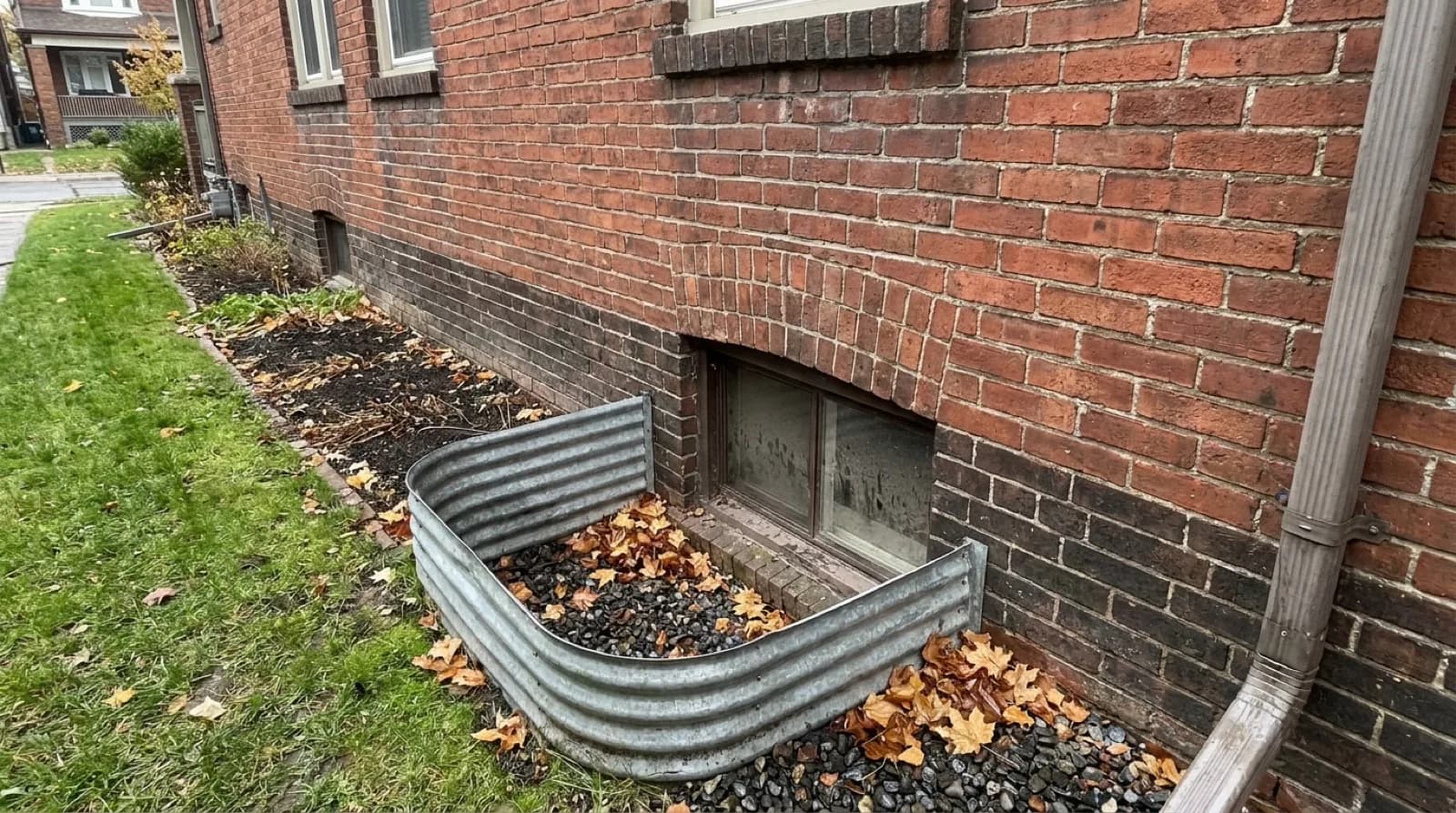
A window well is the metal, plastic or concrete pit dug against the foundation in front of a basement window that sits below the ground. It holds the soil back and lets light reach the glass. It also catches every drop of rain and snowmelt that lands inside it, so the water has to leave somewhere.
The City of Toronto's basement flooding page lists the ways groundwater and stormwater get in. Its list names a crack or leak in "basement windows or door", poor lot grading or drainage, weeping tile failure, overflowing eavestroughs and leaking or plugged downspouts. A leaking window well can involve several of them at once.
In practice the water takes one of three routes. It rises in the well until it reaches the sill and runs over or through the frame. It soaks past a worn seal around the window even when the well is only damp. Or it finds a gap or crack in the concrete around the opening.
Egress Windows Toronto, a GTA installer, puts the first route plainly on its window well page: without drainage, water will collect in the well and leak through the window "regardless of how good your window seal is." That is why the drain at the bottom of the well is the first place to look, before the glass.
Contact
Is there weeping tile in window well drains, and does yours reach it?
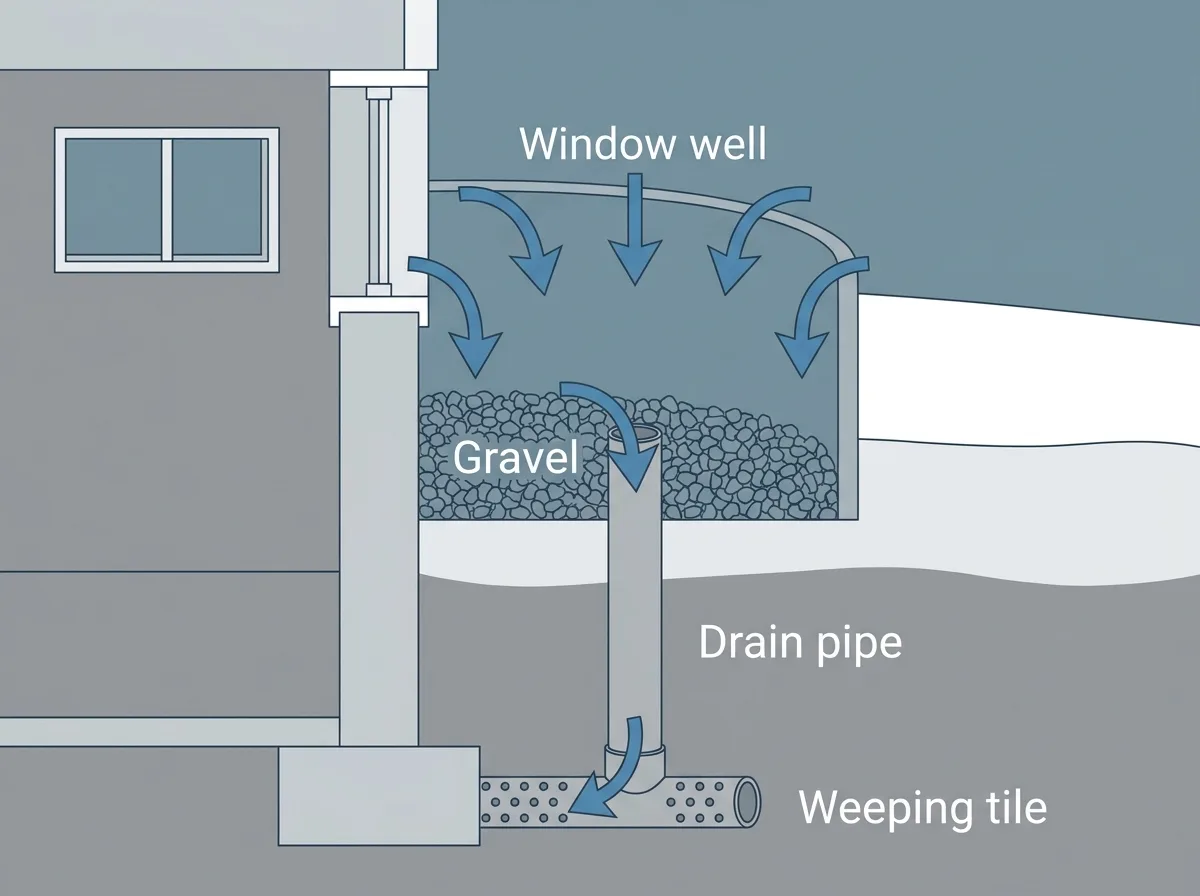
Weeping tile is the perforated drain pipe laid beside the footing, the wide concrete base the foundation wall stands on. It collects groundwater and carries it away to a sump or the sewer connection. The guide to what weeping tile is covers the pipe itself.
A window well is meant to drain down into that system. Total Home Windows and Doors describes proper well drainage as "usually a gravel base tied into the weeping tile, so the well does not fill with water." Leaquida Waterproofing, in its cost breakdown for a window well replacement, describes the drainage line as "Gravel base, drainpipe to weeping tile."
Not every well has that link, and a well can sit on stone with no pipe beneath it. Egress Windows Toronto says the way to check is to inspect the well for drainage, which is "usually seen by manually removing the top layer of gravel."
A drain that is there can still fail. Leaquida's page describes a blocked well drain this way: "silt and debris can clog the vertical drain, causing water to rise like a fish tank and leak through the window seams." The well drain also depends on the weeping tile it feeds, so a clogged line below is worth ruling out too. Companies that work on foundation drains are listed in the weeping tile and drainage directory.
Record
Grading, downspouts and debris: the outside causes
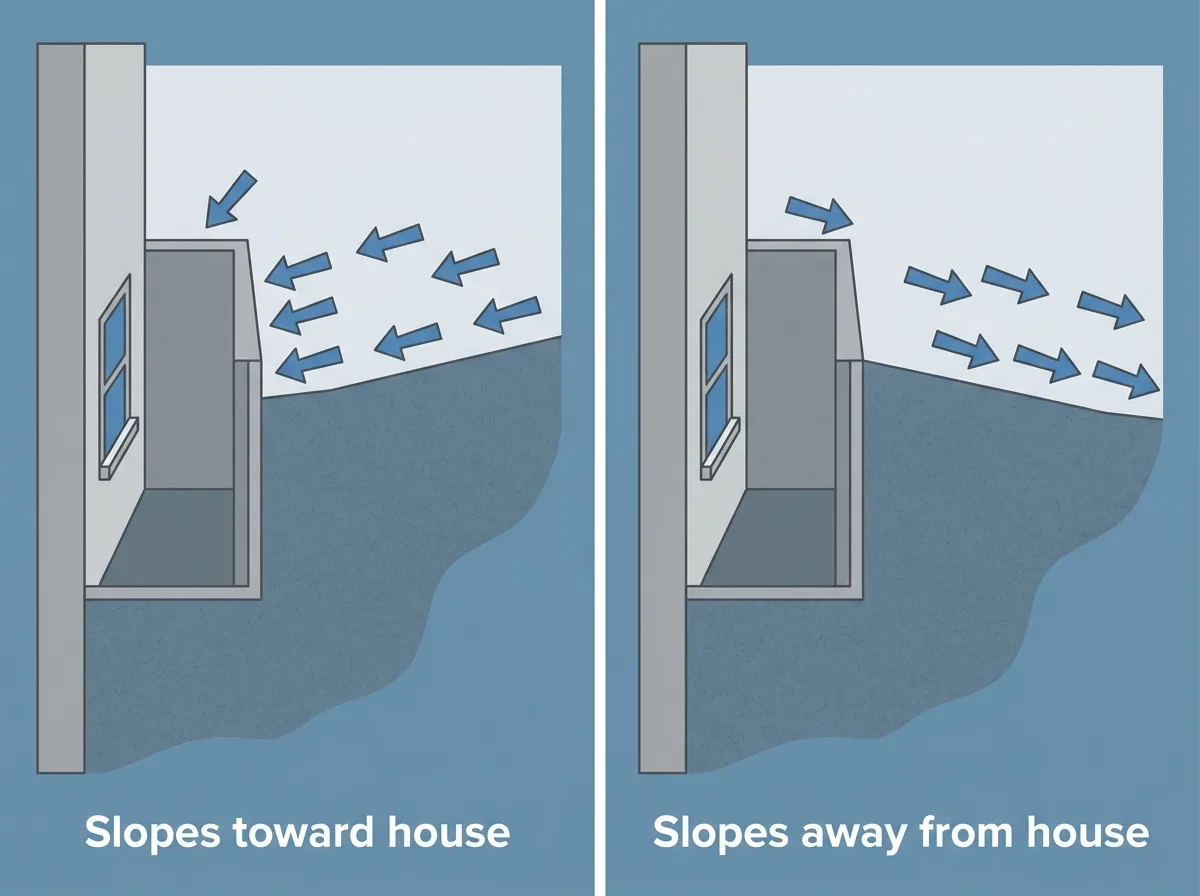
Grading is the slope of the ground around the house. The City of Toronto names poor lot grading as a cause of basement flooding. When soil beside the house has settled, rain runs toward the wall instead of away from it, and a window well is the lowest open spot in that path.
Downspouts add to the load. The City lists leaking or plugged downspouts and overflowing eavestroughs among the causes, and states on the same page that disconnecting downspouts from the sewer system is mandatory. A disconnected downspout that empties beside a window well can send roof water straight into it, so the outlet should point away from the pit.
The rim of the well matters too. Egress Windows Toronto recommends that the top of the well sit at least 2 to 4 inches above grade, so surface water does not pour over the edge. That is the installer's guidance, not a code figure.
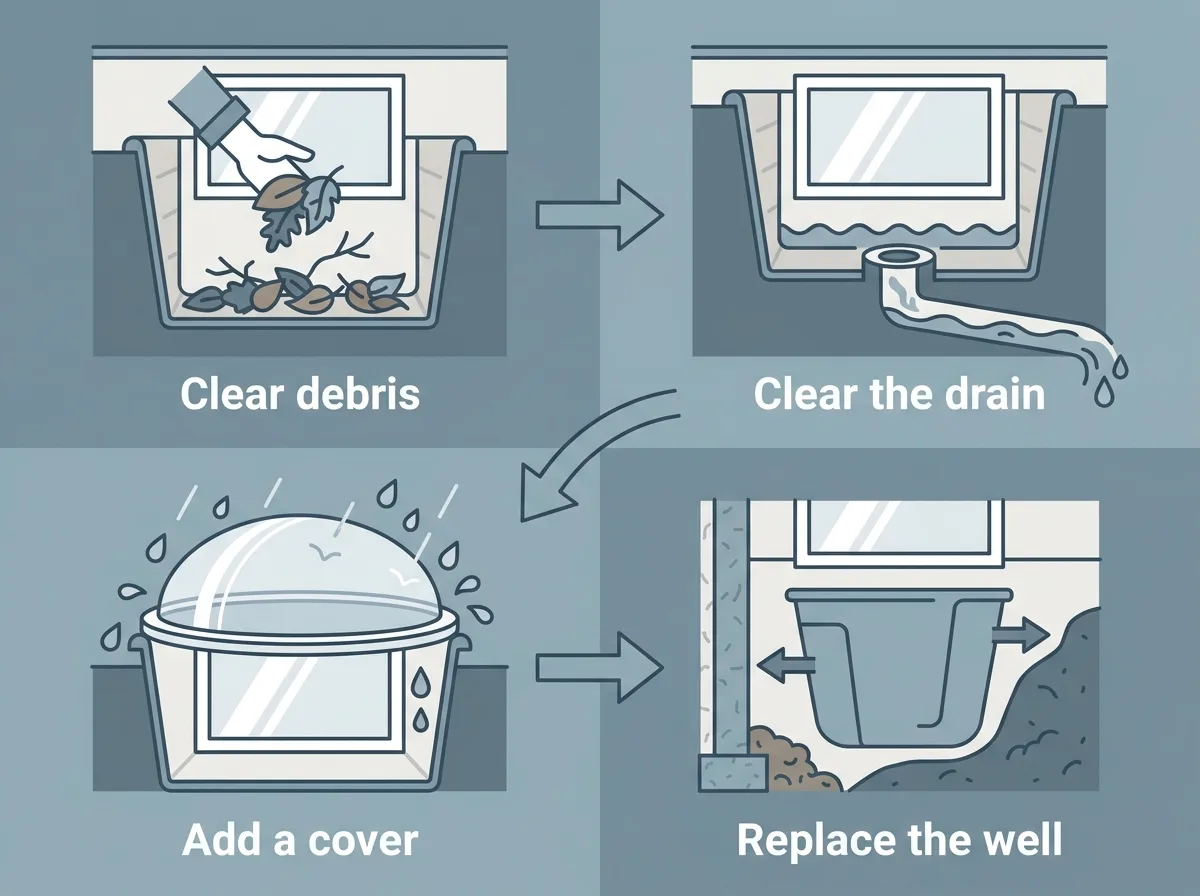
Debris is the cheapest cause to rule out. Egress Windows Toronto writes that "Contamination is the most frequent cause of improper drainage," meaning leaves, soil and litter that pack the gravel. Clearing the well by hand after the leaves drop costs nothing but time. For regrading prices, see the foundation grading cost tool.
Record
Do window well covers stop the leak?
A cover is a clear or solid lid that sits over the well. Leaquida Waterproofing calls a cover "a great first line of defense" against rain, snow and leaves. The same page adds a limit: when the ground is saturated, a cover does not deal with rising groundwater.
So a cover helps most where the water comes from above, such as roof runoff or snow that drifts in and melts. It does little where the water comes up from below through a blocked drain or a high water table, the level of water held in the soil.
Leaquida lists a window well cover at $100 to $300 per well. If the window is an escape route from a bedroom, the cover has to be easy to lift from inside. Egress Windows Toronto writes that a cover on an egress well, the well in front of an escape window, "should be openable from inside the window well without the use of any special tools or expertise." That is the installer's wording; Ontario's own rule is covered further down.
Prices
What do window well repairs cost in Toronto?
Published prices spread widely because the jobs differ. Every figure below is a company's own published number. Not every page says whether tax is included, so ask whether a quote adds Ontario's 13% HST, the rate the Government of Ontario lists.
Small repairs come first. Leaquida Waterproofing lists basic repair at $200 to $600, described as sealing cracks, flushing drains and minor fixes. It lists sealant work at $150 to $400 per well. For drainage, Leaquida prints two different ranges on the same page: $500 to $1,200 in its window well waterproofing table, and $300 to $1,200 in its replacement cost breakdown. Neither is wrong, but a quote should say which scope it covers.
Replacing the whole well costs more. Leaquida puts a full replacement at $1,000 to $5,000 per well, including a new well, drain, seal and finish. Egress Windows Toronto charges $800 to $1,500 as its standard fee for the first well, with a discounted rate on extra wells done in the same visit. Total Home Windows and Doors lists window well construction at $1,500 to $2,500. AquaMaster Plumbing lists window well installation at $1,800 to $3,500 per unit.
Artech Landscaping, in a guide dated 2024, gives $1,000 to $2,000 for a basic fibreglass or plastic well, excluding window replacement. More numbers sit in the egress window cost tool. No single figure here is a market rate. Each is one firm's list price.
Comparison
When the leak is the window or the wall around it
Sometimes the well drains fine and water still gets in. Then the leak may be the window frame, its seal, or the concrete around the opening. The City of Toronto's basement flooding page lists a crack or leak in "basement windows or door" as a cause in its own right.
Resealing an old frame is the smaller job. Replacing the window is larger, and some owners choose a bigger window at the same time. Total Home Windows and Doors lists fitting a new egress window into an existing opening at $1,500 to $4,000. It puts a full basement egress project, with cut-out, window and well, at $4,000 to $7,000 installed.
Water that stands in a well for long periods also pushes on the wall. Leaquida writes that pooling water "exerts hydrostatic pressure against the foundation wall" and over time can lead to cracks around the window frame. Hydrostatic pressure is the force of water held in the soil. The index has not tested that claim; it is the company's statement.
A crack that lets water through is its own repair. The crack injection cost guide sets out published prices for sealing foundation cracks.
Record
What does Ontario say about a basement escape window?
An escape window is a window large enough for a person to climb out in a fire. The Government of Ontario's page on adding a second unit to a house says that where the exit from one unit leads through another unit, "a second means of escape must be provided by using a window." The same page says such windows "must be large enough for a person to get through and be easy to open without the use of tools."
For a ground floor or basement escape window, the Ontario page gives a "minimum area of unobstructed opening not less than 0.38 sq. m (4.1 sq. ft.)". The same Ontario diagram shows 460 mm (18 inches) or more for the openable portion of the window, and 900 mm (2 feet 11 inches) maximum above the floor or steps. The page also shows a diagram of window wells for basement escape windows.
Those are the only escape window figures this article states as rules, and they come from that page. Contractor pages print other clearance and sill figures. Check the current Building Code or ask the City of Toronto building department before a well is sized for escape.
Enlarging a window can be part of adding a basement unit. The guide to basement walkouts and separate entrances covers the entrance side of that project.
Record
What this index holds on window wells and drainage
Of the 42 companies this index files under weeping tile and drainage, 25 use the phrase "window well" somewhere in the website text the index saved for them. Of the 14 companies filed under basement walkouts and entrances, 7 do. Across all 384 listings, 93 do. A mention is not proof that a company does the work, or does it well. It only shows the phrase appears on their site.
WaterproofingIndex charges homeowners and contractors nothing, and no company pays for its place on a list. AquaMaster, one of the companies quoted above, has five records in this index; the index takes no money from it. A request sent through the site's quote form reaches WaterproofingIndex by email, and the site's page for contractors says no enquiry has yet been passed to any company.
The index has never collected a quote for a window well, inspected a well, or tested a drain. The prices above are what named companies publish on their own pages today. They are not what any listed company would charge for a given house.
The index also holds no data on how often window wells cause basement leaks in Toronto, or on how long any repair lasts. Where a page above makes a claim about causes, the article names the page. A written quote after someone has looked at the well, the grading and the drain is the only way to price a specific house.
Frequently asked questions
Why is my window well filling up with water when it rains?
- Usually the drain at the bottom is not working. Leaves and silt can block the gravel or the vertical pipe, the well may have no drain at all, or the weeping tile it feeds may be clogged. Grading that slopes toward the house and a downspout emptying nearby make it worse. Pour water into the well on a dry day and see whether it drains.
Should a window well drain connect to weeping tile?
- Total Home Windows and Doors describes proper window well drainage as usually a gravel base tied into the weeping tile, and Leaquida Waterproofing prices a drainage line described as gravel base and drainpipe to weeping tile at $300 to $1,200 per well. Some older wells have only stone and no pipe, which is worth checking by lifting the top layer of gravel.
How much does it cost to fix a leaking window well in Toronto?
- It depends on the fix. Leaquida Waterproofing lists basic repair at $200 to $600, a cover at $100 to $300 and full replacement at $1,000 to $5,000 per well. Egress Windows Toronto charges $800 to $1,500 for a first well. AquaMaster Plumbing lists installation at $1,800 to $3,500 per unit. Ask whether a quote adds Ontario's 13% HST.
Will a window well cover stop my basement leak?
- It can help when the water comes from rain, snow or leaves falling into the well. Leaquida Waterproofing calls a cover a first line of defence but notes it does not handle rising groundwater when the soil is saturated. If the well fills from below, the drain or the weeping tile needs attention instead.
What size does a basement escape window need to be in Ontario?
- The Government of Ontario's page on adding a second unit shows a ground floor or basement escape window with a minimum unobstructed opening of 0.38 sq. m (4.1 sq. ft.), 460 mm or more for the openable portion, and a maximum of 900 mm above the floor or steps. Confirm with the City of Toronto building department before work starts.
Method
Where the figures on this page came from
This index has never collected a quote. Every figure above is quoted from the source named beside it, or computed from this site’s own listing records.
- City of Toronto, Basement Flooding
- The City of Toronto lists a crack or leak in basement windows or door, poor lot grading or drainage, weeping tile failure, overflowing eavestroughs and leaking or plugged downspouts among the causes of basement flooding.
- City of Toronto, Basement Flooding
- The City of Toronto states that disconnecting downspouts from the sewer system is mandatory.
- Leaquida Waterproofing, Window Well Installation in Toronto
- Leaquida Waterproofing lists full window well replacement at $1,000 to $5,000 per well and basic repair at $200 to $600.
- Leaquida Waterproofing, Window Well Installation in Toronto
- Leaquida Waterproofing prices a window well drainage system at $300 to $1,200 in its replacement breakdown and $500 to $1,200 in its waterproofing table, with a cover at $100 to $300 and sealant at $150 to $400.
- Egress Windows Toronto, Window Well Installation
- Egress Windows Toronto charges $800 to $1,500 as its standard fee for the first window well, with a discount on additional wells in the same visit.
- Total Home Windows and Doors, Egress Windows Toronto & GTA
- Total Home Windows and Doors lists window well construction at $1,500 to $2,500 and a full basement egress project at $4,000 to $7,000 installed.
- AquaMaster Plumbing, Basement Waterproofing Cost Toronto 2026 Price Guide
- AquaMaster Plumbing lists window well installation at $1,800 to $3,500 per unit.
- Artech Landscaping, Budgeting for Basement Window Wells Installation in the GTA (2024)
- Artech Landscaping gives $1,000 to $2,000 for a basic fibreglass or plastic window well in the GTA, excluding window replacement.
- Government of Ontario, Add a second unit to your house
- Ontario's second unit guidance shows a basement escape window with a minimum unobstructed opening of 0.38 sq. m (4.1 sq. ft.), 460 mm or more for the openable portion, and 900 mm maximum above the floor or steps.
- Government of Ontario, Harmonized Sales Tax (HST)
- The Harmonized Sales Tax is currently 13% in Ontario.
Elsewhere