Interior or exterior waterproofing: which one a Toronto basement actually needs
Last updated: By Below-Grade Records Desk
Record
The short answer, and the fork the whole quote hangs on
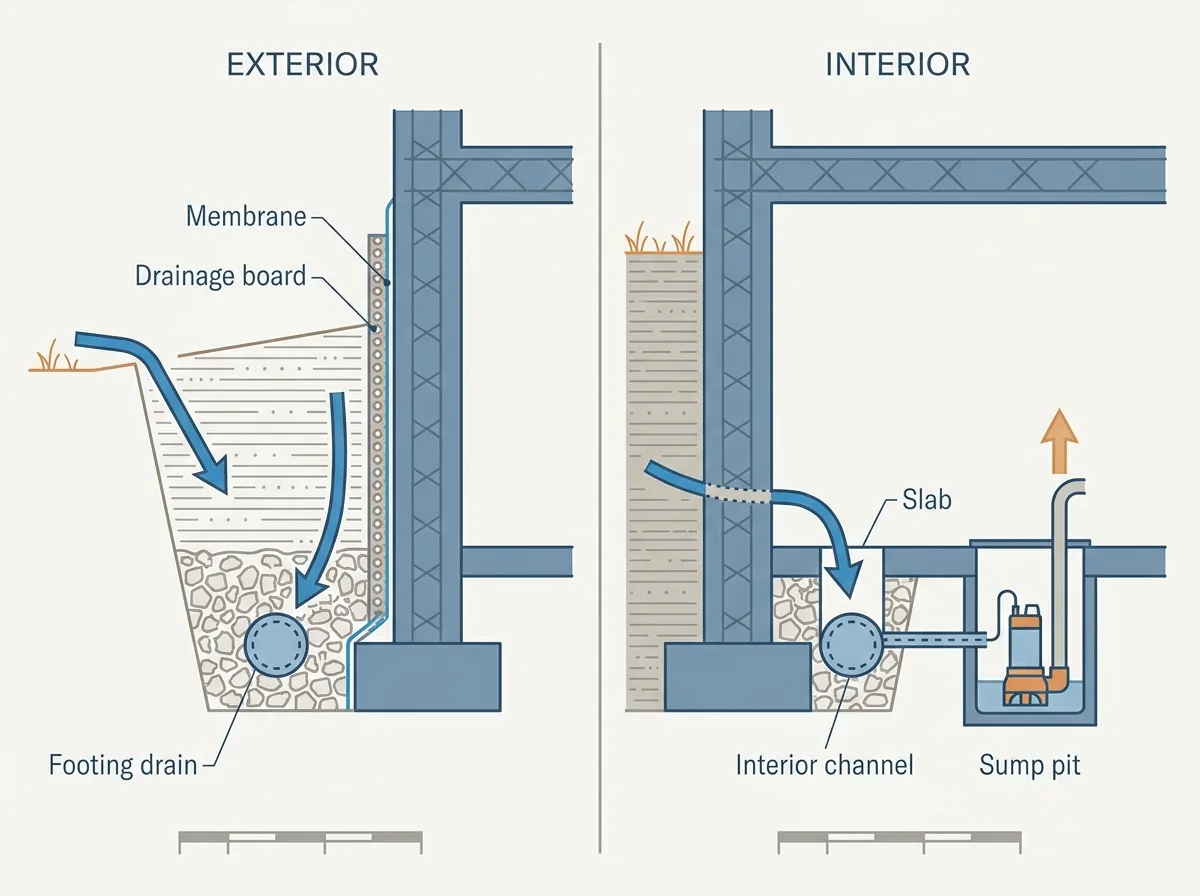
Exterior waterproofing excavates to the bottom of the footing and treats the outside face of the foundation, so water never reaches the wall. Interior drainage cuts a trench inside the slab and carries water that has already reached the wall to a sump. Exterior stops the water. Interior manages it. That single fork decides most of the price.
Almost every confusing waterproofing quote in the GTA is confusing because two contractors priced different products against the same wet corner and neither said so out loud. One is quoting a trench in your yard, soil disposal, membrane, new drain pipe and restored landscaping. The other is quoting a jackhammer, a channel around the inside of the slab, a pit and a pump. Both will describe the result as a dry basement. They will not both be describing the same house afterwards.
This page sets the two side by side using published Canadian contractor pricing, names the source next to every figure, and then says plainly what this index does and does not know about the companies that do the work.
Comparison
What exterior work actually buys
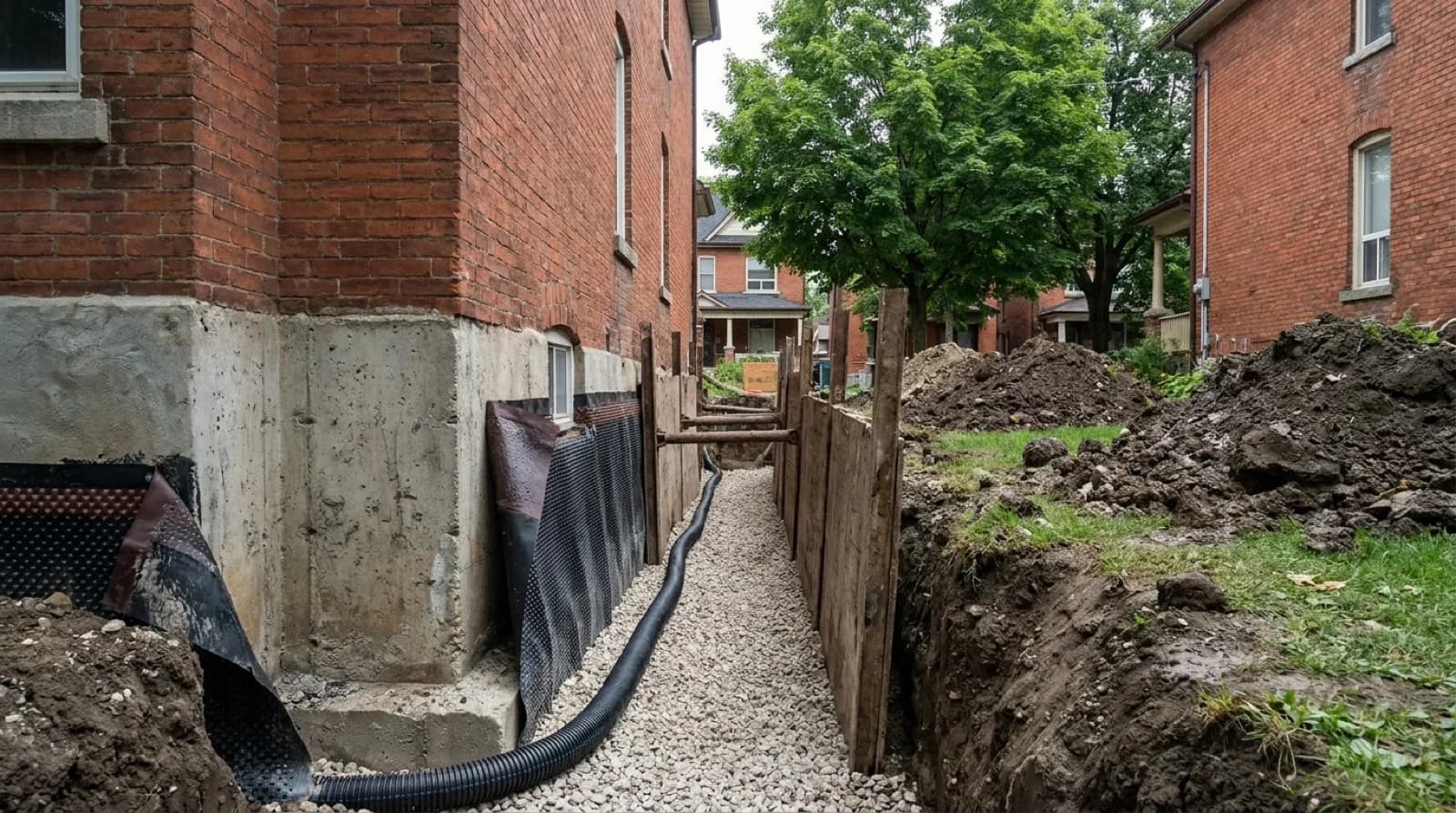
The exterior route means a machine or a crew opens a trench along the wall down to the footing, which OCM Excavation puts at 7 to 9 feet on most GTA homes. The wall is cleaned and parged, a rubberized membrane is applied, a dimpled drainage board goes over it, new perforated pipe is laid in clear stone at the footing, and the trench is backfilled.
What you are buying is the outside face of the wall, treated. The membrane keeps water off the concrete, the dimpled board gives any water that arrives a path straight down, and the new drain takes it away at the footing before it can build pressure. It is the only version of this work that addresses the wall itself, which matters if the wall is deteriorating rather than merely leaking.
OCM Excavation prices exterior excavation and membrane at $250 to $400 per linear foot for a standard 7 foot basement and $300 to $475 per linear foot for an 8 foot one, which the same source says covers most 1960s and newer Toronto bungalows. Nusite Group publishes a lower GTA band of $150 to $300 per linear foot. Both are 2026 GTA figures from named Toronto companies and the gap between them is real, not a typo. Depth and site access explain most of it.
Comparison
What interior drainage actually buys
The interior route is installed from inside the basement. The slab is cut along the perimeter, a drainage channel or perforated pipe is laid beside the footing on the inside, it is tied to a sump pit, and the concrete is patched back. Nothing outside the house is dug up, no soil leaves the site, and no garden, deck or interlock has to be put back afterwards. That is where the price difference comes from.
Project Landscaping publishes an Ontario interior system in three tiers: a basic trench, weeping tile and sump tie at $50 to $80 per linear foot, a full perimeter system with drainage membrane at $70 to $120, and a premium system with a backup pump at $100 to $180. The same source pairs those rates with typical whole project totals of $5,000 to $8,000, $7,000 to $12,000 and $10,000 to $18,000, and notes that most Ontario homes have foundation perimeters between 100 and 150 linear feet.
DryShield puts interior waterproofing for a whole basement perimeter on a typical GTA home at $3,500 to $15,000 and prints the high end open ended, at $15,000 and up rather than as a ceiling. AquaMaster Plumbing prices a complete interior weeping tile system for a whole basement at $3,000 to $10,000.
What interior drainage does not do is keep water out of the wall. The water still crosses the concrete, still wets it, and still carries whatever is dissolved in the soil with it. The system's job starts at the moment the water arrives on the inside face. For a sound poured wall with a seepage problem that is often the correct trade. For a wall that is spalling, bowing, or built of deteriorating block, it treats the symptom and leaves the cause outside in the ground.
Prices
The two prices are not two bids for one job
Lining up an interior quote against an exterior quote and picking the lower number is the most common mistake in this category, and the published rates show why. Project Landscaping's basic interior tier starts at $50 per linear foot. OCM Excavation's 8 foot exterior wall runs to $475 per linear foot. That is close to a tenfold spread, and no part of it is a discount.
The useful comparison is by scope, and the sources make it possible. On the whole house figures, Nusite Group puts a complete exterior perimeter at $15,000 to $35,000 and states the number assumes 100 to 120 linear feet of foundation. OCM Excavation puts a full four wall wrap on an average detached home at $25,000 to $55,000. Against those, DryShield's interior whole basement figure of $3,500 to $15,000 and AquaMaster's $3,000 to $10,000 sit in a different band entirely.
There is a third scope that neither of those captures, and it is the one most homeowners should ask about first. OCM Excavation prices one 30 foot wall, all in with excavation, hauling, parging, membrane, drainage board, new 4 inch PVC weeping tile in clear stone, filter sock and backfill, at $8,500 to $13,500. Water usually enters on one elevation. Paying for that elevation rather than for four is the largest single saving available on the exterior route, and it turns exterior work from a $25,000 decision into a five figure one.
None of these numbers includes tax. Ontario adds 13 per cent HST to waterproofing and drainage contracts, and almost every published contractor rate is quoted before it, so a $25,000 exterior job is closer to $28,250 out the door.
Record
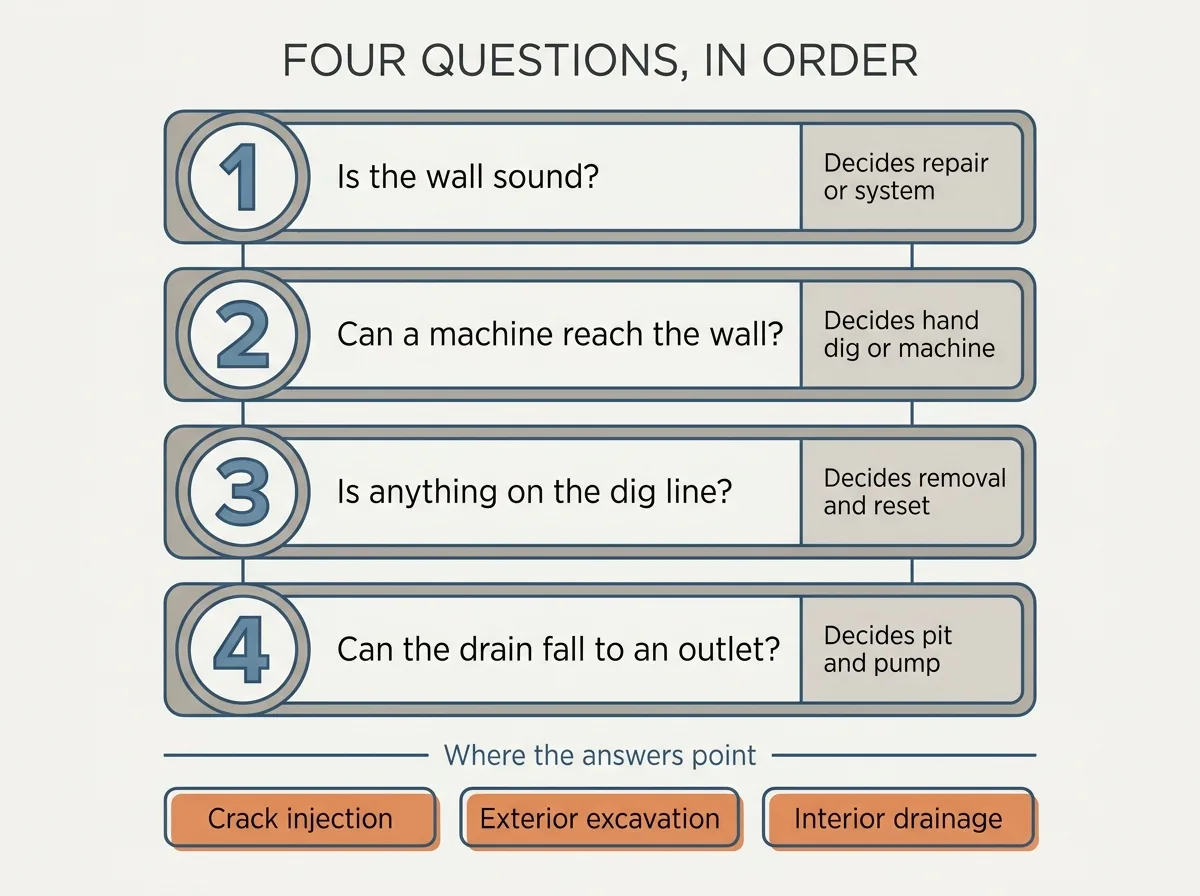
Four things that decide which one your house needs
Nobody can settle this from a price list, and this index is not standing in your basement. What follows is the shape of the decision as the published Canadian sources describe it.
The first question is whether the wall is sound. If the concrete is intact and one vertical crack is passing water, the answer may be neither system. Nusite Group prices professional crack injection at $300 to $800 per crack, and DryShield publishes $750 to $1,000 for polyurethane and $750 to $1,500 for epoxy. Against a perimeter job of $15,000 or more, insisting a contractor shows you why a spot fix will not hold is the cheapest hour you will spend.
The second is access. OCM Excavation notes that Old Toronto lots with side yards around 4 feet cannot fit a mini excavator, which forces a hand dig, and charges $50 to $100 per linear foot on top of everything else for the whole length when that happens. Semi detached and row houses in the old city are the usual case. Access can move an exterior job enough to change the answer.
The third is what is standing on the dig line. Decks, air conditioning condensers and gas meters have to come out and go back, and OCM prices that at $500 to $2,500 depending on what is in the way. Landscaping restoration, sod, interlock, gardens and irrigation, is billed at actual cost by the same source and sits outside the drainage price.
The fourth is where the water leaves. If the new drain can fall to daylight or an existing storm connection, nothing more is needed. Where it has to be lifted, OCM lists a sump pit and pump installed for a storm connection at $2,500 to $4,500 as its own line, and states the work needs a permit and a licensed plumber's sign off. An exterior quote missing that line reads cheaper than one that includes it.
Method
What neither method fixes
Both systems treat water that arrives at the foundation from the soil. Neither one deals with water that arrives through the sanitary sewer, and in Toronto that is a separate and common problem with a separate and much cheaper answer. Rock Basements prices a backwater valve installation at $2,000 to $3,500 and a sump pump installation at $2,200 to $3,000, both before any municipal subsidy. Where sewer backup is the actual failure mode, a perimeter drainage system is the wrong purchase at ten times the price.
Neither method deals with roof water either. The City of Toronto states that every property owner in Toronto must ensure their downspouts are disconnected from the City's sewer system. A disconnected downspout that discharges beside the foundation is pouring the roof of the house into the exact soil the drainage system is trying to keep dry, and correcting the discharge point costs a fraction of anything on this page.
And neither method is a warranty against a wall that is moving. A horizontal crack, a bow, or ongoing settlement is a structural question, and the GTA price lists for that work start at $3,000 for carbon fibre straps on one wall at Toronto Basement Underpinning and run to $15,000 to $40,000 per wall for a rebuild at the same source. Waterproofing a wall that is failing structurally buys a dry version of the same problem.
Record
Disruption, restoration and the lines that go missing
Price is not the only axis, and the two routes differ on almost every other one. The exterior route puts a trench through the yard, the machine access route and whatever is planted on it. The interior route puts a jackhammer through the basement floor, which means dust through the house, and it usually means removing finished flooring, framing and drywall along the walls being treated first.
Restoration is where quotes on both sides get quietly thin. On the exterior side OCM Excavation marks landscaping restoration as actual cost, separate from the drainage work, and the same source cites Ontario Regulation 406/19, which requires soil characterization on many larger jobs and turns disposal on a full perimeter dig into a budget line rather than an afterthought. On the interior side, patching the slab is normally included, but putting a finished basement back is normally not.
The practical instruction is the same for both. Ask for the quote itemized rather than as one number, and ask specifically for the lines that are easiest to omit: the outlet and whether a pit and pump are in the price, restoration, disposal, and permit. A contractor who has priced those lines can show them to you. A contractor who has not is quoting a smaller job than the one they will perform.
Record
What this index holds, and what it does not
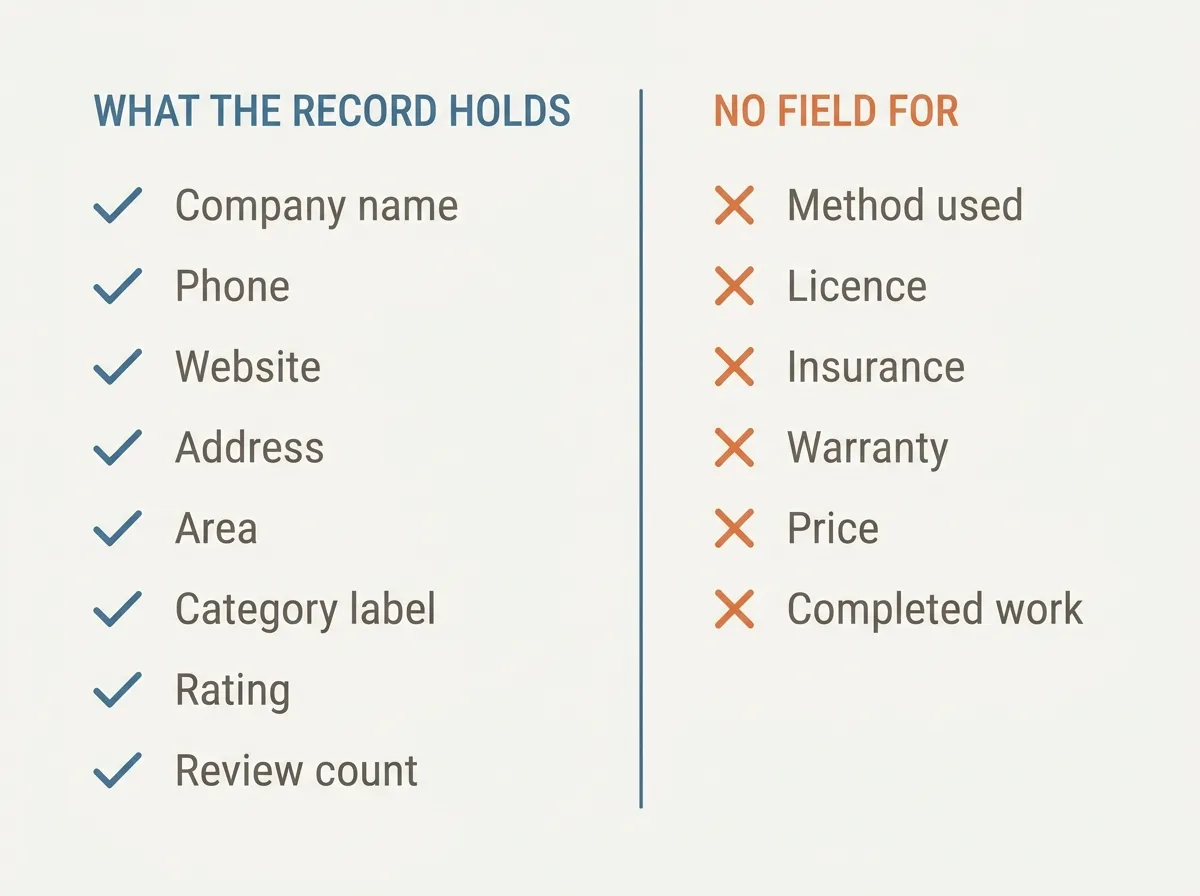
WaterproofingIndex catalogues 384 companies across 59 Toronto and GTA areas. Of those, 225 carry the basement waterproofing label, and they appear in 46 of the 59 published areas. 215 of the 225 have a website on record and 222 have a phone number. 214 carry a Google rating, and the average across those 214 is 4.83, which is a number about how Google reviews behave in this trade rather than a number about workmanship.
Here is the fact that matters most for this particular question. The records hold no field for method. Nothing in this index says which of those 225 companies excavates and which sells interior systems only, because that information was never in the source data. The category label describes what a company is listed for, not how it works. So this site cannot shortlist you an exterior contractor, and any directory that claims it can, on data of this shape, is guessing.
What a list like this is good for is the part the price research cannot do for you. Every published Canadian source on this page says the same thing in different words: get three itemized quotes against one written scope. The value of 225 names in 46 areas is that finding three companies to ask is no longer the hard part. Comparing what they wrote down is.
Frequently asked questions
Is interior or exterior basement waterproofing better?
- They solve different problems. Exterior excavation treats the outside face of the wall so water never reaches it, which is the route when the wall itself is deteriorating. Interior drainage collects water that has already crossed the wall and takes it to a sump, which is the route when a sound wall is seeping and digging the yard is impractical. Cost follows the method: roughly $50 to $180 per linear foot interior against $150 to $475 exterior across the GTA sources here.
How much does exterior waterproofing cost for one wall in Toronto?
- OCM Excavation prices a single 30 foot wall, all in, at $8,500 to $13,500. That covers excavation, hauling, parging, rubberized membrane, dimpled drainage board, new 4 inch PVC weeping tile in clear stone, filter sock and full backfill. The same source puts a full four wall wrap on an average detached home at $25,000 to $55,000. Add 13 per cent HST to both.
Can I do interior drainage instead of digging up my yard?
- Often yes, and it is why the interior route exists. DryShield puts interior waterproofing for a whole basement on a typical GTA home at $3,500 to $15,000 and up, against $15,000 to $35,000 for a complete exterior perimeter at Nusite Group. The trade off is that the water still crosses the wall. If the concrete or block is deteriorating rather than simply seeping, interior drainage keeps the floor dry and leaves the cause in the ground.
Should I fix the crack first?
- Ask the question before anyone quotes a perimeter. Nusite Group prices professional crack injection at $300 to $800 per crack and DryShield publishes $750 to $1,000 for polyurethane and $750 to $1,500 for epoxy. If one crack in a sound wall is the whole problem, that is a small fraction of either system, and a contractor recommending the larger job should be able to show you why a spot fix will not hold.
Does the City of Toronto pay for waterproofing?
- Not for the waterproofing itself. The City of Toronto Basement Flooding Protection Subsidy Program offers up to $6,650 per property, but it covers flood protection devices rather than drainage systems: a plumbing assessment, backwater valves, a sump pump, a battery backup and foundation drain severance, each at up to 80 per cent of the invoiced cost to its own maximum. Check the current terms with the City before counting on any of it.
Method
Where the figures on this page came from
This index has never collected a quote. Every figure above is quoted from the source named beside it, or computed from this site’s own listing records.
- Project Landscaping (Ontario)
- Interior drainage runs $50 to $80 per linear foot for a basic system, $70 to $120 with a drainage membrane and $100 to $180 with a backup pump, paired with whole project totals of $5,000 to $8,000, $7,000 to $12,000 and $10,000 to $18,000. Most Ontario homes have foundation perimeters between 100 and 150 linear feet.
- DryShield (Toronto and Southern Ontario)
- Interior waterproofing for a whole basement perimeter on a typical GTA home costs $3,500 to $15,000 and up, and interior drainage runs $70 to $150 per linear foot.
- Nusite Group (Toronto)
- Exterior membrane waterproofing runs $150 to $300 per linear foot in the GTA, with a complete foundation perimeter at $15,000 to $35,000 assuming 100 to 120 linear feet.
- OCM Excavation and Construction (Richmond Hill, serving Toronto and the GTA)
- Exterior excavation and membrane runs $250 to $400 per linear foot for a 7 foot basement and $300 to $475 for an 8 foot one, a single 30 foot wall all in is $8,500 to $13,500, a full four wall wrap is $25,000 to $55,000, a hand dig where a mini excavator will not fit adds $50 to $100 per linear foot, obstructions on the dig line cost $500 to $2,500, and a sump pit and pump for a storm connection is $2,500 to $4,500.
- Nusite Group (Toronto)
- Professional foundation crack injection costs $300 to $800 per crack as a spot fix.
- Rock Basements (GTA)
- A backwater valve installation costs $2,000 to $3,500 and a sump pump installation $2,200 to $3,000, both before any municipal subsidy.
- City of Toronto
- The Basement Flooding Protection Subsidy Program offers up to $6,650 per property, and all property owners in Toronto must ensure their downspouts are disconnected from the City's sewer system.
Elsewhere