Is basement waterproofing worth it in Toronto?
Last updated: By Below-Grade Records Desk
Comparison
What can "worth it" honestly mean for a Toronto basement?
No source here gives the odds that your basement will flood next spring. This index holds no flood records for any street and no quotes of its own.
What it can do is set two groups of published prices side by side. One is what Toronto area contractors say repairs cost. The other is what restoration companies say it costs to dry out and rebuild a basement after water gets in. The City of Toronto subsidy sits between the two, because it pays part of some repairs and none of others.
That comparison helps, but it is not a formula. A repair that costs less than one cleanup is easy to defend. A repair that costs more than several cleanups needs a better reason than worry, such as water you can already see coming in.
Most contractor pages quoted here do not say whether tax is included, and OCM calls its wall price "all-in". The Government of Ontario says the Harmonized Sales Tax is currently 13% in Ontario, so ask whether a quote includes it. The City subsidy works differently: its page says eligible costs include labour, materials and taxes.
Comparison
Is basement waterproofing worth it for the problem you have?
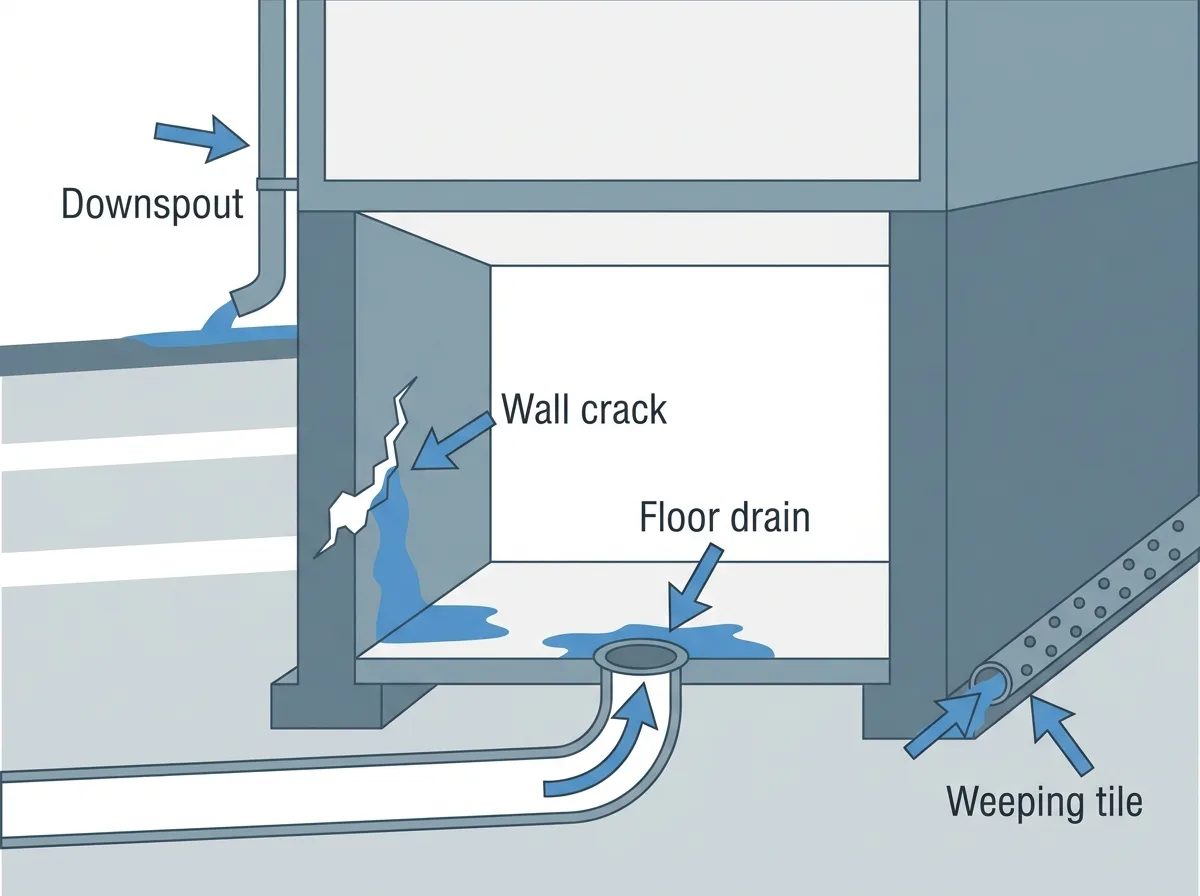
It depends on where the water comes from, because "waterproofing" covers very different jobs. Weeping tile is the perforated pipe laid around the base of a foundation to carry groundwater away. A membrane is a rubbery sheet or coating on the outside of the wall. An interior system is a drain cut into the basement floor along the walls, feeding a sump pump, which is a pump in a pit that pushes the water outside.
A single damp line on one wall often points to a crack, and a crack can be sealed on its own. Water that shows up only in heavy rain can come from outside the wall: the City of Toronto's basement flooding page names leaking or plugged downspouts and poor lot grading among the causes. Dirty water rising through a floor drain is a sewer backup. No wall membrane stops that. A backwater valve, a flap in the main drain that closes when sewer water flows back toward the house, is the part built for it.
Seepage along several walls, where the floor meets the wall, is the case where a full interior or exterior system starts to make sense. The index's tool that walks through why a basement is leaking sorts these signs. Only someone who looks at your walls can say which one you have.
Prices
What does a flooded basement cost to clean up?
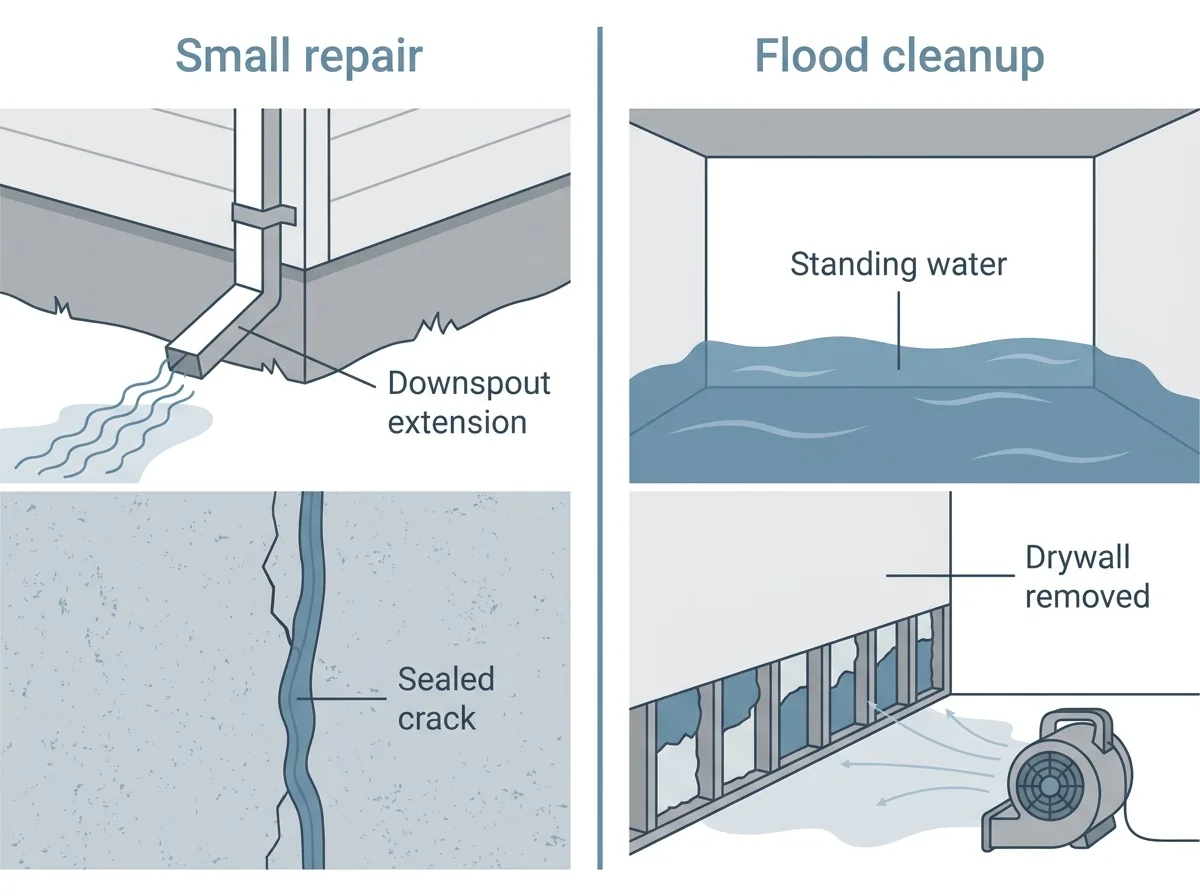
Restoration companies price a flood by how dirty the water is and how much of the room has to come out. ProLine Restoration, on its Toronto pricing page, calls clean water Category 1 and lists sewage backup under Category 3, or black water. Dirtier water means more wet drywall and flooring gets thrown away.
ProLine prices a minor loss, clean water in a single room caught quickly, at $2,500 to $4,000. It prices a major loss, with extensive flooding and reconstruction needed, at $8,000 to $15,000, and gives a full basement flood and a sewer backup as examples of that tier.
24/7 Remedial Services is an Ontario restoration company, and its figures are not specific to Toronto. Its page gives two ranges for Category 3 sewage. One table lists a sewer backup at $12,000 to $35,000 or more. Another passage puts a sewage loss with full containment and disposal at $8,000 to $25,000 or more.
For a finished basement of 1,000 square feet it gives $6,000 to $14,000 for the drying and cleanup stage alone, and $20,000 to $50,000 or more once the rebuild is included. It describes the first stage, which it calls mitigation, as extraction, drying and antimicrobial treatment, and it counts wall materials, paint, flooring and trim as the rebuild on top. The index's flooded basement cleanup cost tool gathers these ranges in one place.
Each of those numbers describes one event. None of these companies says how often a given house floods, and this index has no way to say it either.
Prices
Which repairs cost less than one cleanup?
Some fixes cost far less than the bottom of ProLine's minor tier. Custom Contracting lists a downspout extension or splash pad at $20 to $60. Project Landscaping says proper grading around a home costs $1,500 to $4,000. Grading means shaping the soil so rain runs away from the wall. Both deal with water on the surface before it reaches the foundation.
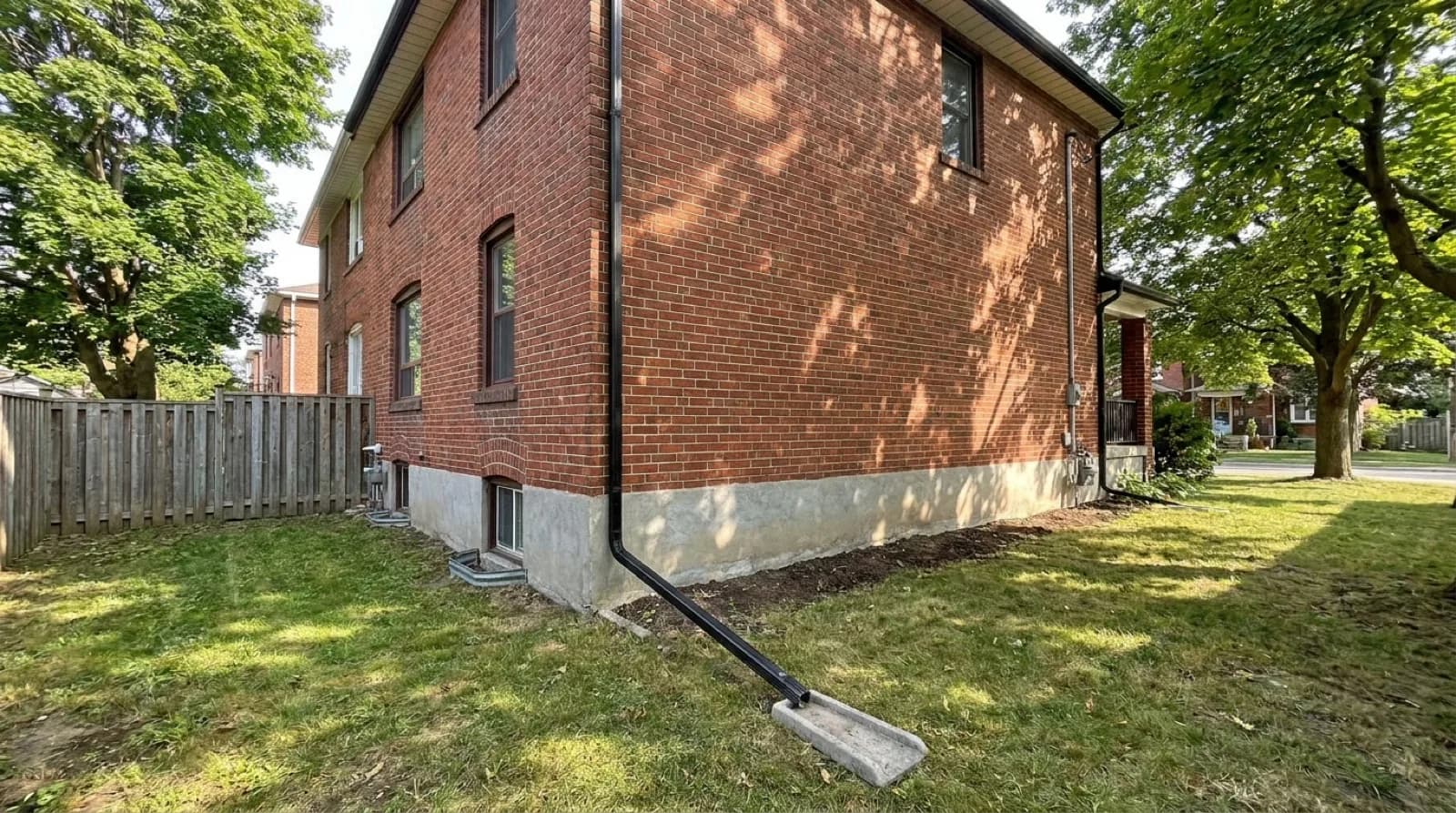
The City of Toronto's downspout page says it is mandatory for all property owners to have their downspouts disconnected from the City's sewer system, and that water should flow away from a building's foundation. A downspout that empties right beside the wall is worth fixing before anything larger.
A leaking crack is the next step up. Crack injection means pumping a liquid resin into the crack from inside, where it sets and seals the gap. Nusite Group, a Toronto waterproofer, lists crack injection at $300 to $800 per crack. Nusite says the price depends on the length and complexity of the crack. The crack injection cost page collects more published rates.
For sewer backup, Tornado Plumbing & Drains prices a standard mainline backwater valve retrofit in a finished Toronto basement at $2,800 to $4,200, with the permit and inspection included. That range sits below the $6,000 that 24/7 Remedial Services gives as the low end for cleaning up a 1,000 square foot finished basement.
Prices
When does full waterproofing cost more than the flood?
Whole basement systems are a different size of spend. Nusite Group lists an interior weeping tile system at $8,000 to $18,000 for average basements, and exterior foundation waterproofing at $15,000 to $35,000 for typical homes. OCM Excavation, a Richmond Hill contractor serving Toronto, prices a full four-wall exterior wrap on an average detached home at $25,000 to $55,000.
Put those next to the smaller cleanup tiers and the gap is plain. The low end of OCM's full wrap, $25,000, is above the top of ProLine's major tier, which ends at $15,000.
The larger cleanup figures tell a different story. ProLine lists a severe tier, with structural damage and large reconstruction, at $15,000 to $40,000 or more, and 24/7 Remedial Services puts a full restoration of a 1,000 square foot finished basement at $20,000 to $50,000 or more. One bad flood in a finished basement can land in the same range as the dig. The comparison only comes out clean against the smaller tiers, and none of these sources says which kind of flood a given house would get. For a basement that has stayed dry and has little finished space to lose, the published prices give no reason to start with a full wrap.
The case gets stronger when water already comes in along several walls, or when a dig is happening anyway for another reason. The job itself can shrink when the trouble sits on one side of the house. OCM prices one typical 30-foot wall on a Toronto semi at $8,500 to $13,500 all-in, so a leak confined to one wall may not need all four dug.
No source here promises that a large job ends flooding for good. A sewer backup arrives through the drains, not through the walls. Ask for a quote that splits out each part of the work; the guide to what a basement waterproofing quote should itemize lists the lines to look for, and the Toronto basement waterproofing cost guide collects the published rates by method.
Prices
What does the City of Toronto subsidy cover, and what does it leave out?
The City of Toronto's Basement Flooding Protection Subsidy Program page says that as of May 1, 2026, the City offers up to $6,650 in subsidies per property, for eligible work completed on or after November 12, 2025. The same page says each item is paid at up to 80% of the invoiced cost.
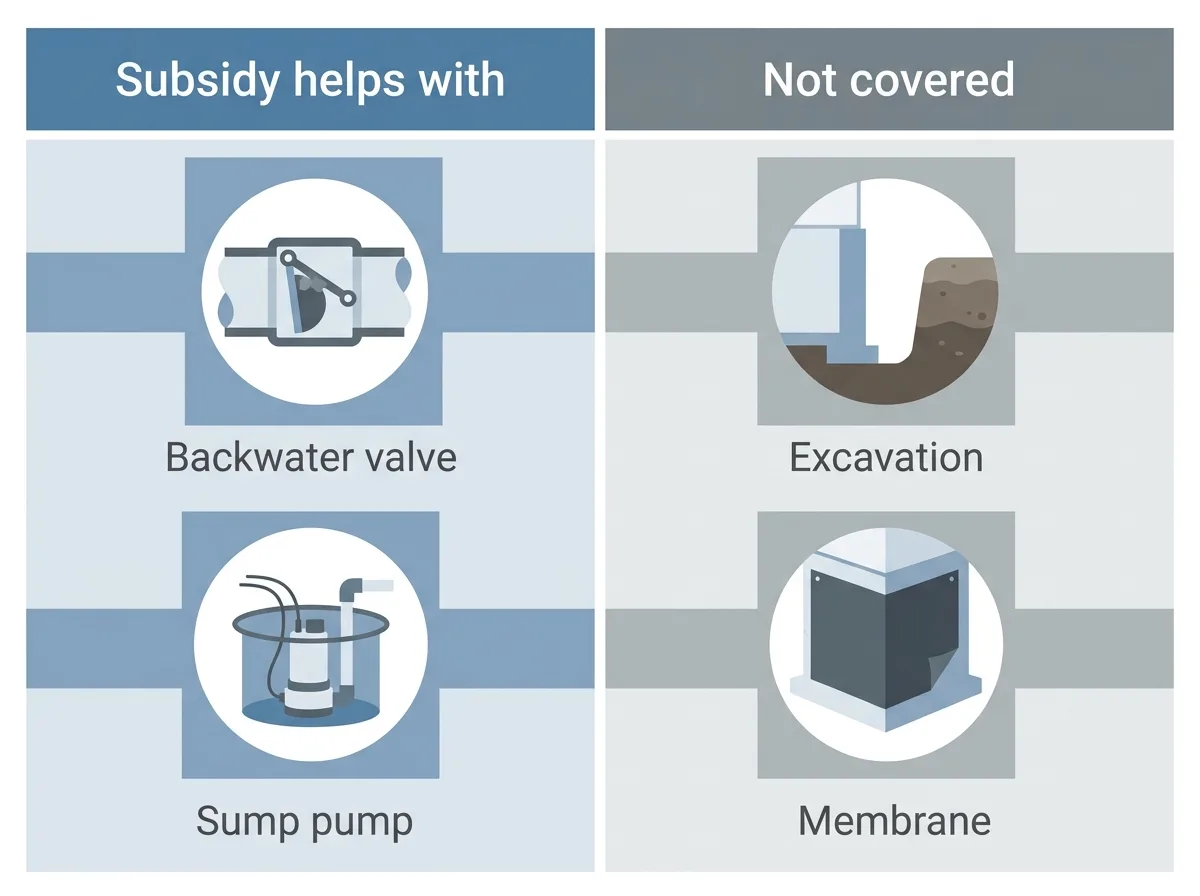
The City lists these limits. A one-time home plumbing assessment gets up to $500. Each backwater valve gets up to $1,600, for up to two devices. One sump pump gets up to $2,250, plus $300 for a battery backup. Severing and capping a foundation drain connection to the sewer gets up to $400. Excavation, membranes and new weeping tile do not appear on that list, so the waterproofing itself gets nothing. The City page also says that disconnecting downspouts is not eligible for a subsidy.
That tilts the numbers toward the plumbing parts. Tornado Plumbing & Drains works out its own standard valve retrofit at $1,200 to $2,600 after the rebate. The City page also warns that an application does not guarantee a subsidy. Money goes out first come, first served, and depends on annual funding approved by City Council. Your contractor must hold a valid City of Toronto business licence at the time of the work, or the City denies the funding. The 2026 guide to the Toronto basement flooding subsidy covers the full rules.
Record
What this index holds on basement waterproofing
Of the 384 companies in this index, 225 are filed under basement waterproofing. Of those 225, 65 are also filed under sump pumps and backwater valves, and 62 under foundation repair. Within that group, 215 list a website and 222 list a phone number. These counts come straight from the index's listing file.
What the index does not hold matters more for this question. It has not collected a quote from any of these companies, and it does not record which companies hold a City of Toronto business licence. It has no flood history for any address.
Every price in this guide comes from a company's own published page, named in the sentence where it appears. A real quote for your house may land outside those ranges, in either direction.
WaterproofingIndex charges homeowners and contractors nothing, and no company pays for its place on a list. Two of the companies quoted here, Nusite and Tornado Plumbing & Drains, also have records in this index; the index takes no money from them. A request sent through the site's quote form reaches WaterproofingIndex by email, and the site's page for contractors says no enquiry has yet been passed to any company.
Frequently asked questions
Is basement waterproofing worth it if my basement has never leaked?
- No source in this guide gives the odds of a dry basement flooding, so price is the only fair test. Cheap steps such as downspout extensions and grading cost far less than one cleanup. A full exterior wrap, which OCM Excavation prices at $25,000 to $55,000 for an average detached home, is hard to defend on price alone when no water has come in.
Is foundation repair worth it?
- It depends on what is wrong. A single leaking crack is a small job: Nusite Group lists crack injection at $300 to $800 per crack. Walls that bow inward or cracks that keep widening are a structural question, not a flood cleanup question, and they need an assessment by someone qualified to judge the structure before any price comparison makes sense.
Does the City of Toronto subsidy pay for basement waterproofing?
- No. The City's eligible work list covers a home plumbing assessment, backwater valves, a sump pump with battery backup, and severing and capping a foundation drain connection. Excavation, membranes and new weeping tile are not on it. The City also says downspout disconnection is not eligible, even though disconnected downspouts are a condition of the program.
Is a backwater valve a replacement for waterproofing?
- No, they solve different problems. A backwater valve closes the main drain when sewer water flows back toward the house. Waterproofing deals with groundwater coming through the walls or floor. Tornado Plumbing & Drains prices a standard valve retrofit in a finished basement at $2,800 to $4,200, while Nusite Group lists an interior weeping tile system at $8,000 to $18,000.
How much does it cost to clean up a flooded basement in Toronto?
- ProLine Restoration prices a minor clean water loss in one room at $2,500 to $4,000 and a major loss needing reconstruction at $8,000 to $15,000. 24/7 Remedial Services gives $6,000 to $14,000 to dry out a 1,000 square foot finished basement, and $20,000 to $50,000 or more once the rebuild is included.
Method
Where the figures on this page came from
This index has never collected a quote. Every figure above is quoted from the source named beside it, or computed from this site’s own listing records.
- City of Toronto, Basement Flooding Protection Subsidy Program
- As of May 1, 2026, the City of Toronto offers up to $6,650 in basement flooding subsidies per property, at up to 80% of each invoiced item.
- City of Toronto, Mandatory Downspout Disconnection
- It is mandatory for all Toronto property owners to have their downspouts disconnected from the City's sewer system.
- Government of Ontario, Harmonized Sales Tax (HST)
- The Harmonized Sales Tax is currently 13% in Ontario.
- ProLine Restoration, Water Damage Restoration Cost in Toronto
- A minor clean water loss in one room costs $2,500 to $4,000, a major loss needing reconstruction $8,000 to $15,000, and a severe loss with structural damage $15,000 to $40,000 or more.
- 24/7 Remedial Services, Ontario Water Damage Restoration Cost
- A Category 3 sewer backup costs $12,000 to $35,000 or more, and a 1,000 square foot finished basement costs $6,000 to $14,000 to dry out and $20,000 to $50,000 or more with the rebuild.
- Nusite Group, How Much Does Waterproofing Cost in Toronto
- Exterior foundation waterproofing costs $15,000 to $35,000 for typical homes, an interior weeping tile system $8,000 to $18,000, and crack injection $300 to $800 per crack.
- OCM Excavation & Construction, Basement Waterproofing Excavation Cost Toronto 2026
- A full four-wall exterior wrap on an average detached home costs $25,000 to $55,000, and one typical 30-foot wall on a Toronto semi $8,500 to $13,500.
- Tornado Plumbing & Drains, Backwater Valve Installation Cost Toronto 2026
- A standard mainline backwater valve retrofit in a finished basement costs $2,800 to $4,200, or $1,200 to $2,600 after the rebate.
- Custom Contracting, Eavestrough and Downspout Cost Ontario
- A downspout extension or splash pad costs $20 to $60.
- Project Landscaping, Foundation Waterproofing Costs in Ontario
- Proper grading around a home costs $1,500 to $4,000.
- City of Toronto, Basement Flooding
- The City of Toronto names leaking or plugged downspouts and poor lot grading or drainage among the causes of basement flooding.
Elsewhere