What a backwater valve protects, and what it leaves unprotected
Last updated: By Below-Grade Records Desk
Record
What the valve does, mechanically
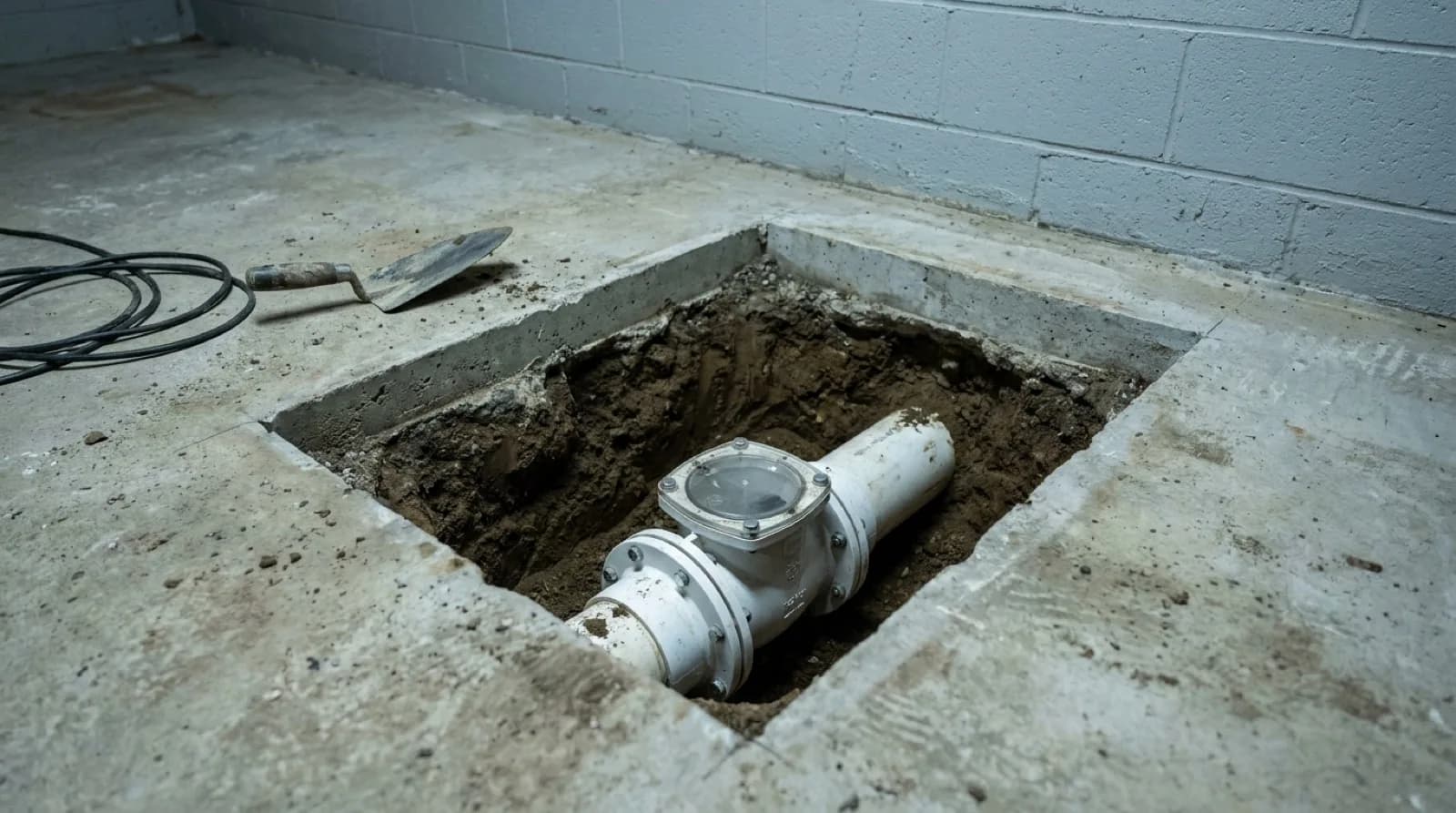
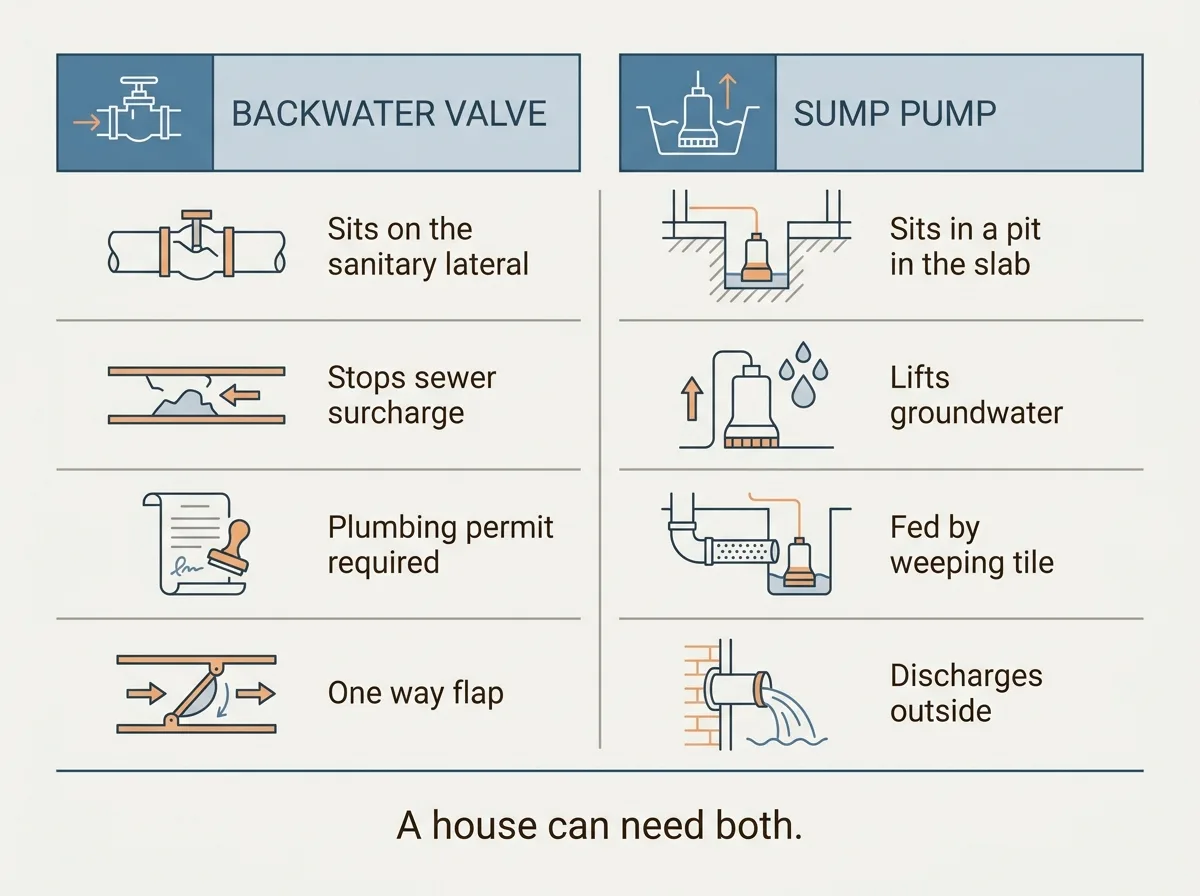
A mainline backwater valve is a one way gate installed in the sanitary lateral, the pipe that carries everything from your house out to the City sewer. In normal use a flap sits open and flow passes over it. When the City sewer surcharges during a heavy storm and flow tries to run backwards toward the house, the flap closes and the lateral is sealed.
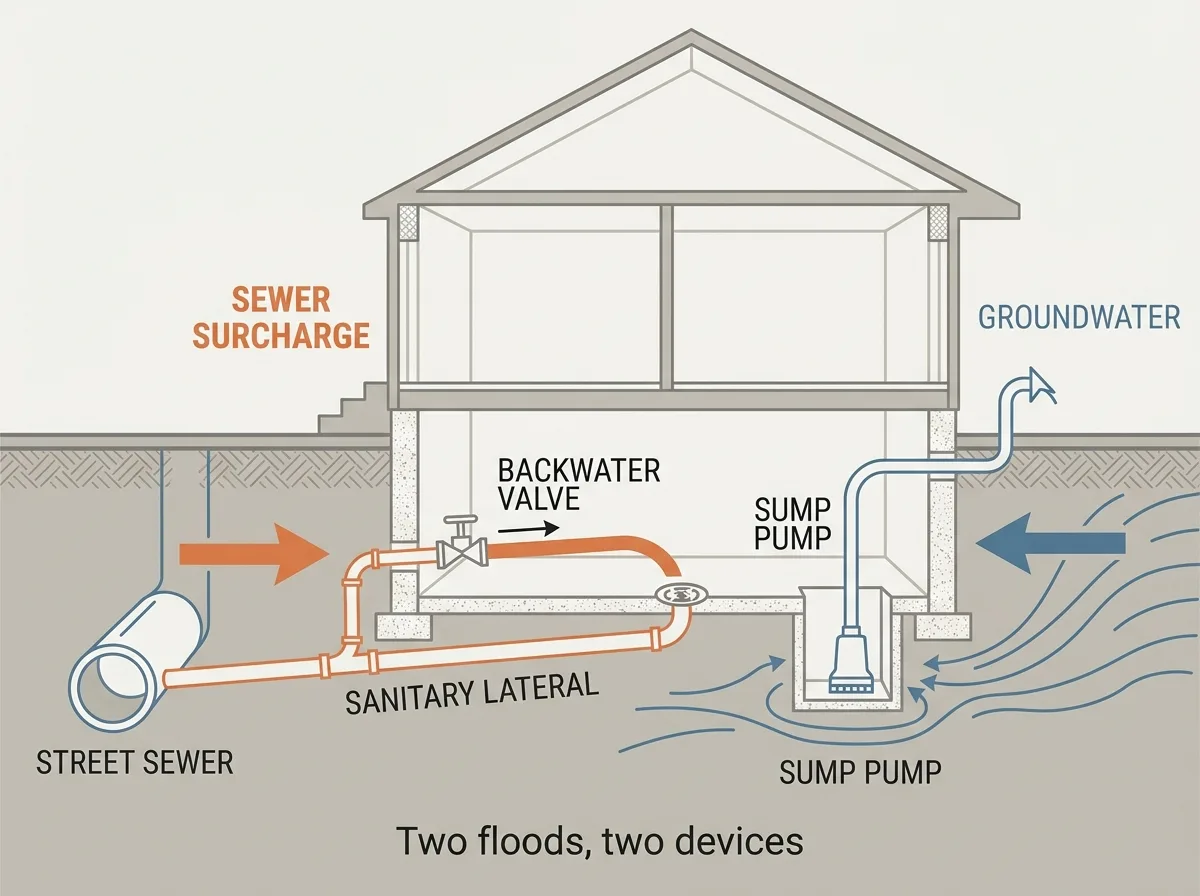
That is the entire mechanism, and it explains both its value and its limit. It protects against one specific failure: sewage entering the house through floor drains, basement toilets and laundry standpipes because the public sewer is over capacity. In a Toronto basement flood, that is one of the two common causes.
The other cause is groundwater, and the valve has no relationship to it at all. Water coming through a foundation crack, past a failed weeping tile, or up through the slab arrives from the soil, not from the sewer. Installing a backwater valve to solve a seeping wall is spending $3,000 on the wrong pipe.
Prices
What a Toronto retrofit costs
Retrofitting a valve into an existing house means saw cutting the basement slab, excavating to the lateral, cutting the pipe, fitting the valve body with its access cover, then restoring the concrete. The state of the basement above that pipe is what moves the price.
Tornado Plumbing prices a standard retrofit in a finished basement at $2,800 to $4,200 per valve before subsidy, and its easiest case, where the slab is unfinished or a pit already exists, at $1,800 to $2,800. Where the lateral runs under a load bearing wall, mechanical equipment is in the way, or the service is unusually deep, the same source prices the work at $4,200 to $6,500.
Canada Waterproofers prices an interior backwater valve installation at $2,000 to $3,500 and up, printing the high end open ended rather than as a ceiling. Rock Basements publishes $2,000 to $3,500 for a backwater valve installation on its own table of average GTA waterproofing costs.
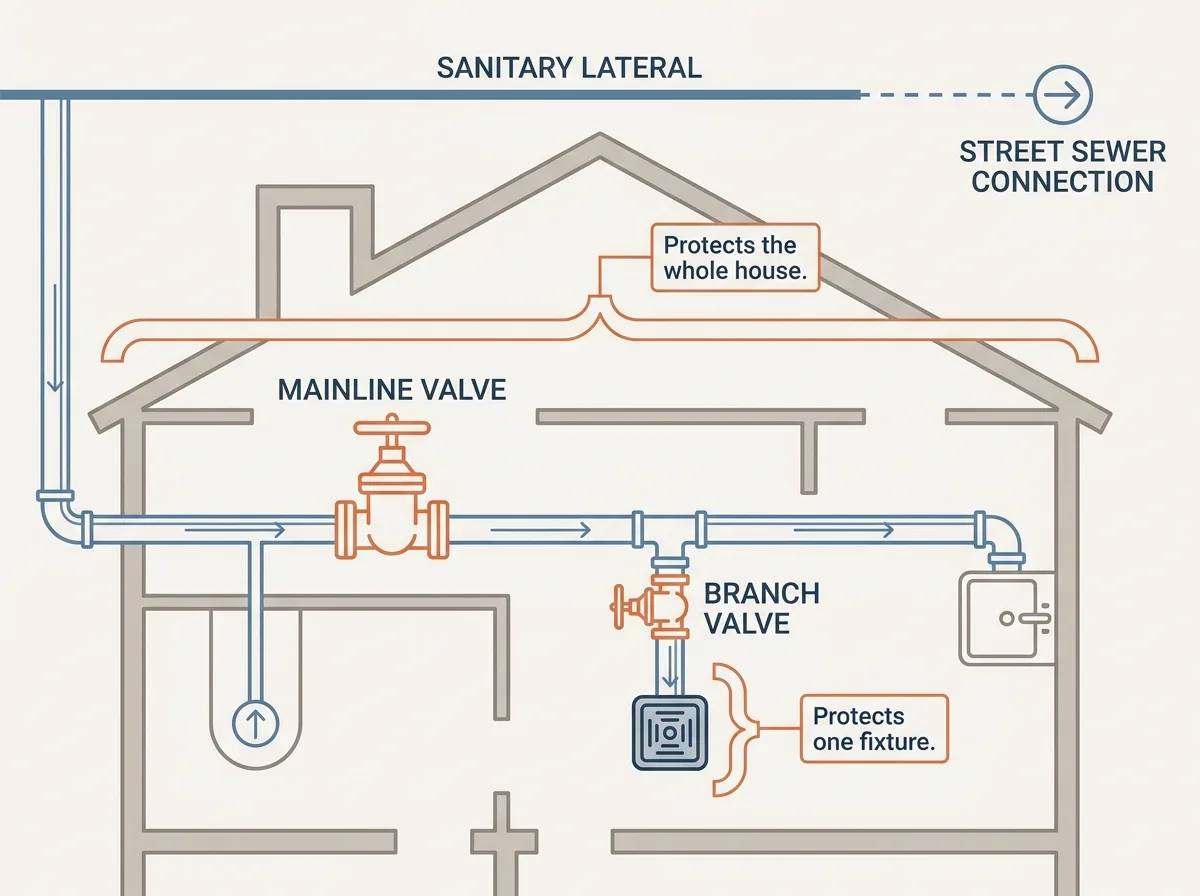
There is a cheaper device that is not the same device. Tornado Plumbing prices a single fixture branch backwater valve, which protects one drain such as a basement floor drain rather than the whole house, at $650 to $1,400, and warns it is not eligible for the full $1,600 subsidy in some cases. If a quote comes in far under the mainline band, that is the first thing to check.
Add 13 per cent HST to all of these. The City's subsidy programme, discussed below, treats taxes as part of the invoiced cost it reimburses against.
Record
The permit is not optional, and it is not the expensive part
Toronto requires a plumbing permit for this work and an inspection before the valve is covered up. Tornado Plumbing prices the permit plus inspection coordination at $190 to $340 and states both are mandatory, which makes this a line item rather than an optional extra.
The sequence matters more than the fee. An inspection that has to happen before the slab is patched is an inspection that has to be scheduled into the job, not after it. A contractor who pours the concrete back first has created a problem that costs far more than $340 to undo.
The City is also explicit that who does the work decides whether you get paid. Its guidance is that an unlicensed contractor means no funding at all, and it publishes a Business Licence Lookup and a phone line, 416-392-6700, to check a contractor's City of Toronto business licence before work starts. Against a subsidy worth up to $1,600 per valve, five minutes on that lookup is the highest paid work in the whole project.
On the money itself, the City of Toronto Basement Flooding Protection Subsidy Program offers up to $6,650 in subsidies per property as of 1 May 2026, with the expanded amounts applying to eligible work completed on or after 12 November 2025. Backwater valves are covered at up to 80 per cent of the invoiced cost to a maximum of $1,600 per device for up to two devices. This site publishes a separate guide to what that programme pays and what disqualifies an application, and the terms change, so confirm them with the City before you count on the money.
Comparison
One valve, or a valve and a pump
The two devices in this category solve the two different floods, and a house can genuinely need both. A backwater valve stops the sewer coming back. A sump pump lifts groundwater collected by the weeping tile and sends it away from the house.
Tornado Plumbing prices a primary sump pump dropped into an existing pit at $1,400 to $2,400 and a new pit cut into a finished basement slab at $2,800 to $4,500, and names the pit as the single biggest swing in the price. MBM Plumbing in Markham publishes lower figures, $500 to $1,200 for a replacement in an existing pit and $1,200 to $2,500 for a basic new installation. Canada Waterproofers prices the pit excavation itself as a $1,050 to $2,700 add on where no pit exists.
Battery backup is priced two ways in the GTA. Tornado Plumbing charges $1,200 to $2,400 to retrofit a backup onto an existing primary pump, and $3,500 to $6,500 for a primary and a backup supplied together as one system in a sealed basin with dual check valves, battery pack and alarm.
One warning specific to the drainage side. Where the weeping tile currently discharges into the sanitary sewer, which is against Toronto's bylaw, OCM Excavation prices severing it and adding a sump pit and pump for a storm connection at $2,500 to $4,500. That situation makes a backwater valve more urgent rather than less: with the foundation drain feeding the same lateral, a surcharged sewer has a second route into the house.
Questions
What to ask before you sign
Four questions separate a complete quote from a cheap one on this job.
Is it a mainline valve or a single fixture valve? Tornado Plumbing's $650 to $1,400 branch valve protects one drain. Its $2,800 to $4,200 mainline retrofit protects the house. Both are legitimate products and they are not alternatives to each other.
Is the permit and inspection in the price? At $190 to $340 it is a small line, but it is mandatory, and a quote that omits it is either absorbing it silently or has not planned for the inspection at all.
What happens to the floor? A saw cut through a finished basement floor means the finish above it needs putting back, and slab restoration is where quotes on this job quietly differ.
What is the maintenance? A backwater valve has an access cover so the flap can be checked and cleared. Canada Waterproofers prices an annual sump pump inspection at $150 to $250 per visit for a visual check and float test, and the valve should be on the same walk round. A flap held open by debris is a valve that is not there.
Record
What this index holds on this trade
WaterproofingIndex catalogues 384 companies across 59 Toronto and GTA areas. One hundred and sixty of them carry the sump pumps and backwater valves label, which makes it the second largest category on the site after basement waterproofing. They appear in 41 of the 59 published areas, and all 160 have both a phone number and a website on record.
The most informative thing in those records is the label Google Maps gives each business, because it is not the label this site gives them. Of the 160, 101 are listed as a plumber, 51 as a waterproofing service, 3 as a drainage service, and the remainder as a construction company, a restoration service or a repair service. Backwater valve work in Toronto is a plumbing trade, and the roster reflects that.
That is a practical result rather than a trivia point. The permit for this work is a plumbing permit, the City's inspection is a plumbing inspection, and the majority of the companies listed for it are plumbers. If your shortlist for a backwater valve is made entirely of waterproofing companies, you have shopped a narrower market than exists.
One hundred and fifty eight of the 160 carry a Google rating, averaging 4.90 across those 158, and half of the rated companies carry 85 reviews or fewer. Those numbers describe how reviews accumulate in a trade people call in an emergency, not workmanship. This index holds no licence field, no insurance field, no price and no record of completed work, so every dollar figure on this page is quoted from the Canadian source named beside it, and the licence check belongs on the City's own lookup rather than here.
Frequently asked questions
What does a backwater valve actually stop?
- It stops sewage travelling back up the sanitary lateral into the house when the City sewer surcharges during a storm. A flap in the pipe closes as soon as flow reverses. It protects floor drains, basement toilets and laundry standpipes from that one failure, and it has no effect on groundwater arriving through a foundation wall, a crack or the slab.
How much does a backwater valve cost in Toronto?
- Tornado Plumbing prices a standard retrofit in a finished basement at $2,800 to $4,200 before subsidy, $1,800 to $2,800 where the slab is unfinished, and $4,200 to $6,500 where access is difficult. Canada Waterproofers prices an interior installation at $2,000 to $3,500 and up, and Rock Basements publishes $2,000 to $3,500. Add 13 per cent HST, then subtract whatever the City subsidy pays.
Do I need a permit for a backwater valve in Toronto?
- Yes. Toronto requires a plumbing permit and an inspection before the valve is covered up. Tornado Plumbing prices the permit plus inspection coordination at $190 to $340 and states both are mandatory. Schedule the inspection into the job rather than after it, because a slab poured back before the inspection has to come up again.
Do I need a sump pump as well?
- Only if you have the other flood. A sump pump lifts groundwater collected by the weeping tile; a backwater valve blocks the sewer. Houses with both problems need both devices. Tornado Plumbing prices a primary pump in an existing pit at $1,400 to $2,400 and $2,800 to $4,500 where a new pit has to be cut into a finished slab, which it names as the biggest swing in that price.
Should I call a plumber or a waterproofing company?
- Both are listed for this work, and the roster leans plumber. Of the 160 companies in this index carrying the sump pumps and backwater valves label, 101 are listed by Google Maps as a plumber and 51 as a waterproofing service. The permit is a plumbing permit and the inspection is a plumbing inspection, so a shortlist made only of waterproofing companies is a narrower market than the one that exists.
Method
Where the figures on this page came from
This index has never collected a quote. Every figure above is quoted from the source named beside it, or computed from this site’s own listing records.
- Tornado Plumbing and Drains (Toronto)
- A standard finished basement backwater valve retrofit costs $2,800 to $4,200 before subsidy and $1,200 to $3,200 net after the $1,600 City rebate; the easiest case is $1,800 to $2,800 and a difficult access case $4,200 to $6,500; a single fixture branch valve is $650 to $1,400; the plumbing permit plus inspection coordination is $190 to $340; a primary sump pump in an existing pit is $1,400 to $2,400 and $2,800 to $4,500 with a new pit; a battery backup retrofit is $1,200 to $2,400 and a combined primary plus backup system $3,500 to $6,500.
- Canada Waterproofers (Ontario, Toronto and the GTA)
- An interior backwater valve installation costs $2,000 to $3,500 and up, sump pit excavation where no pit exists adds $1,050 to $2,700, and an annual sump pump inspection is $150 to $250 per visit.
- Rock Basements (GTA)
- A backwater valve installation costs $2,000 to $3,500 and a sump pump installation $2,200 to $3,000.
- MBM Plumbing (Markham)
- A sump pump replacement in an existing pit costs $500 to $1,200 and a basic new installation $1,200 to $2,500.
- OCM Excavation and Construction (Richmond Hill, serving Toronto and the GTA)
- Severing weeping tile from the sanitary sewer and adding a sump pit and pump for a storm connection costs $2,500 to $4,500.
- City of Toronto, Basement Flooding Protection Subsidy Program
- The Basement Flooding Protection Subsidy Program offers up to $6,650 per property as of 1 May 2026, with backwater valves covered at up to 80 per cent of the invoiced cost to a maximum of $1,600 per device for up to two devices, and an unlicensed contractor means no funding at all.
Elsewhere